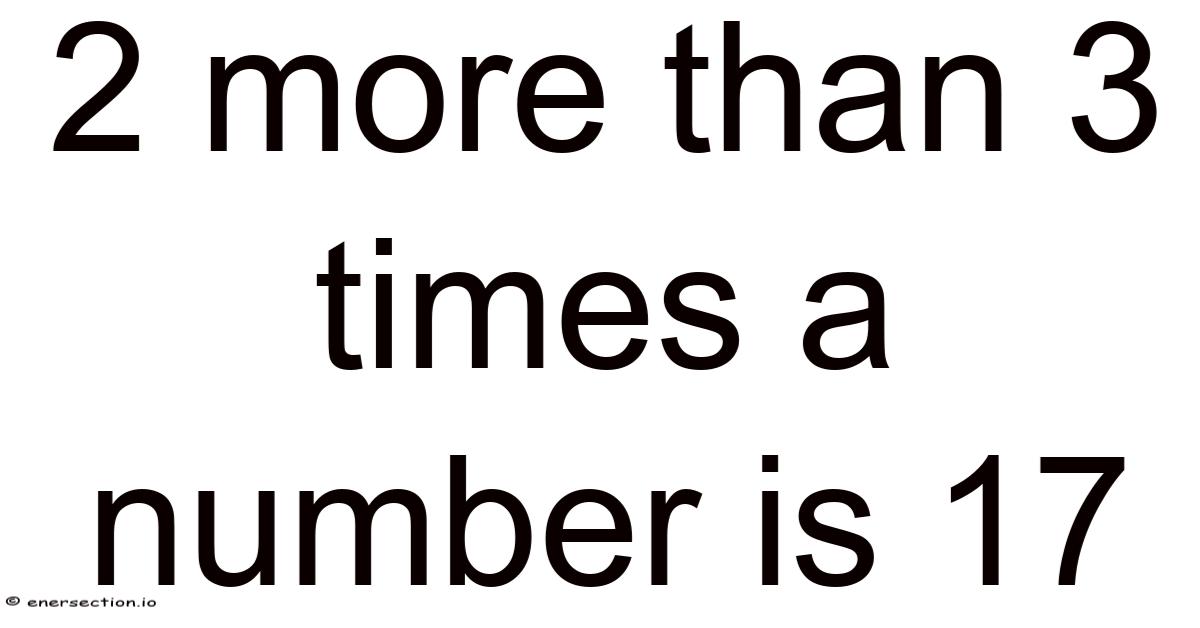
Solving the Equation: "2 More Than 3 Times a Number is 17"
Algebra is a fundamental branch of mathematics that allows us to solve problems by representing unknown values with variables. One common type of problem involves translating verbal statements into mathematical equations. Day to day, the phrase “2 more than 3 times a number is 17” is a classic example that helps build foundational skills in algebra. This article will guide you through understanding, setting up, and solving this equation step by step Easy to understand, harder to ignore..
Understanding the Problem
The statement “2 more than 3 times a number is 17” can be broken down into parts:
- “A number” refers to an unknown value, usually represented by a variable like x.
- “3 times a number” means 3x.
- “2 more than 3 times a number” translates to 3x + 2.
- “Is 17” means the expression equals 17.
Putting it all together, the equation becomes:
3x + 2 = 17
This is a linear equation in one variable, and our goal is to find the value of x that makes the equation true.
Steps to Solve the Equation
To solve 3x + 2 = 17, we need to isolate the variable x on one side of the equation. Here’s how to do it:
Step 1: Subtract 2 from Both Sides
We start by eliminating the constant term on the left side. To maintain the balance of the equation, whatever operation we perform on one side must also be done on the other side Not complicated — just consistent..
3x + 2 - 2 = 17 - 2
Simplifying both sides gives:
3x = 15
Step 2: Divide Both Sides by 3
Now, to isolate x, divide both sides of the equation by the coefficient of x, which is 3:
3x ÷ 3 = 15 ÷ 3
This simplifies to:
x = 5
Step 3: Verify the Solution
It’s always good practice to check whether the solution is correct. Substitute x = 5 back into the original equation:
3(5) + 2 = 15 + 2 = 17
Since the left side equals the right side, x = 5 is indeed the correct solution.
Scientific Explanation: Inverse Operations
The process of solving equations relies heavily on inverse operations—operations that undo each other. In this problem:
- Addition and subtraction are inverses.
- Multiplication and division are inverses.
By applying inverse operations in the correct order (following the reverse of the order of operations, often remembered by PEMDAS), we systematically isolate the variable. First, we subtracted 2 (the inverse of adding 2), and then we divided by 3 (the inverse of multiplying by 3).
Common Mistakes to Avoid
When solving equations like this, students often make a few typical errors:
- Incorrectly translating the verbal statement: As an example, misinterpreting “2 more than 3 times a number” as 2 + 3x instead of 3x + 2. While mathematically equivalent due to the commutative property of addition, clarity in setup is crucial.
- Forgetting to apply operations to both sides: An equation remains balanced only when the same operation is performed on both sides.
- Arithmetic errors: Simple mistakes like subtracting 2 from 17 incorrectly (e.g., getting 16 instead of 15) can lead to wrong answers.
Frequently Asked Questions (FAQ)
Q1: What does “2 more than 3 times a number” mean?
It means you multiply the number by 3 and then add 2. If the number is x, the expression is 3x + 2 That's the part that actually makes a difference..
Q2: Why do we subtract 2 first before dividing by 3?
We follow the reverse order of operations. Since multiplication (3 times x) is done before addition (+2) in the original expression, we undo addition first, then multiplication.
Q3: Can I solve this equation in a different way?
Yes, you could first divide everything by 3, but that would complicate the fractions. The standard method of undoing addition before multiplication is simpler and more efficient Which is the point..
Q4: How do I know if my answer is correct?
Substitute your solution back into the original equation. If both sides are equal, your answer is correct.
Conclusion
Understanding how to translate verbal statements into algebraic equations is a critical skill in mathematics. Think about it: the equation “2 more than 3 times a number is 17” provides a clear example of how to approach such problems. By following systematic steps—subtracting 2 from both sides and then dividing by 3—we find that x = 5. Mastering these techniques not only helps solve similar problems but also builds a strong foundation for more advanced topics in algebra and beyond. Remember, practice is key, and checking your work ensures accuracy and confidence in your solutions.
Conclusion
Understanding how to translate verbal statements into algebraic equations is a critical skill in mathematics. The equation “2 more than 3 times a number is 17” provides a clear example of how to approach such problems. By following systematic steps—subtracting 2 from both sides and then dividing by 3—we find that x = 5. Mastering these techniques not only helps solve similar problems but also builds a strong foundation for more advanced topics in algebra and beyond. Remember, practice is key, and checking your work ensures accuracy and confidence in your solutions.
This structured approach to problem-solving—breaking down verbal phrases, applying inverse operations methodically, and verifying results—is invaluable across disciplines, from science to finance. Think about it: as you encounter more complex equations, the principles demonstrated here will remain a reliable framework. Embrace challenges, refine your strategies, and let each solved equation reinforce your mathematical intuition. With persistence, even the most daunting problems become manageable, and every solution becomes a stepping stone toward greater mastery. Keep exploring, keep questioning, and let algebra illuminate the patterns that govern the world around us.
The true value of mastering algebra extends far beyond any single equation. By learning to decode language into mathematical structure, you develop a logical framework that applies to coding, engineering, economics, and everyday decision-making. Stay diligent, remain inquisitive, and approach every new problem with the confidence that you now possess the tools to unravel it. These problem-solving instincts—identifying unknowns, establishing relationships, and verifying outcomes—are the very skills that drive progress across countless fields. As you continue to study, remember that each challenge is an invitation to grow. The world is full of questions waiting to be answered, and with algebra at your side, you are well equipped to discover their solutions.
In the long run, the journey from a simple sentence to a numerical answer is more than just a classroom exercise; it is an exercise in critical thinking. By transforming the abstract into the concrete, you learn to strip away distractions and focus on the core relationship between variables. This ability to isolate a variable is a metaphor for solving problems in real life: identifying the noise, removing the constants, and uncovering the truth Small thing, real impact..
As you move forward, challenge yourself by creating your own word problems or seeking out real-world scenarios where these equations apply. Whether you are calculating interest rates, measuring dimensions for a home project, or analyzing data for a report, the logic of algebra remains the same. The more you integrate these patterns into your thinking, the more intuitive the process becomes, turning what once felt like a chore into a powerful tool for discovery Not complicated — just consistent. Worth knowing..
Conclusion
In a nutshell, the transition from verbal descriptions to algebraic expressions is the bridge between language and logic. By consistently applying the rules of inverse operations and maintaining a disciplined approach to verification, any learner can handle the complexities of algebra with ease. While the specific numbers may change, the methodology remains constant. By embracing this systematic process, you do more than just find the value of x—you develop a mindset of precision and persistence that will serve you in every academic and professional endeavor. Keep practicing, stay curious, and trust in the process of mathematical discovery.
