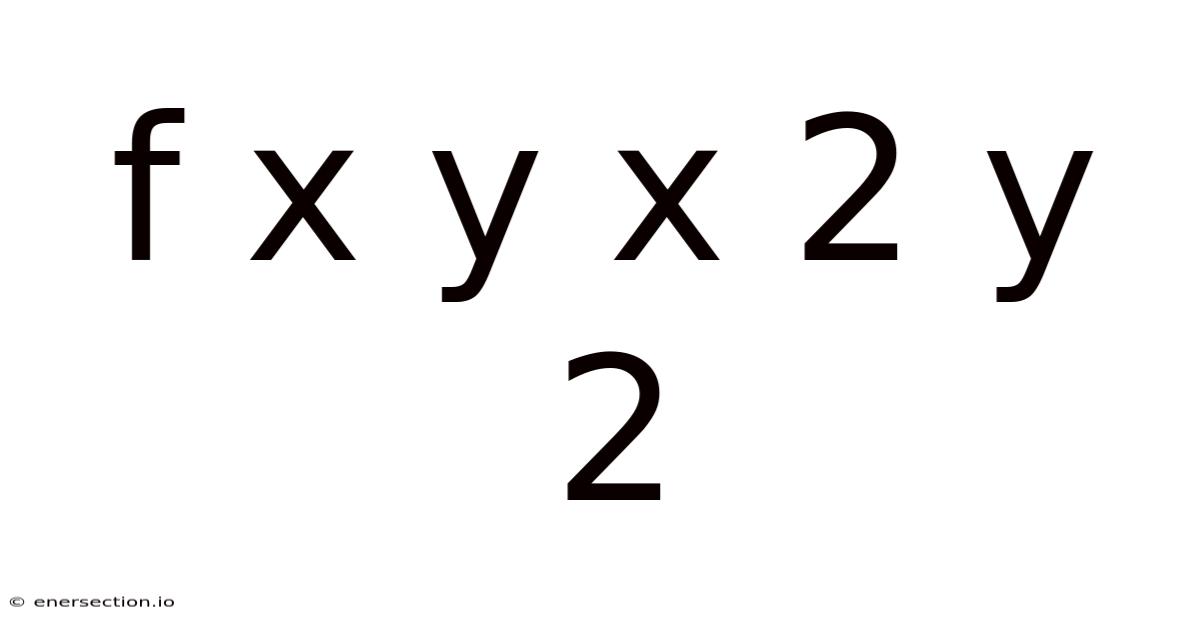
Understanding the Function f(x, y) = x² + y²: A Journey from a Simple Equation to Profound Concepts
At first glance, the expression f(x, y) = x² + y² appears deceptively simple. It is one of the most fundamental and elegant functions in mathematics, serving as a cornerstone for understanding geometry, algebra, calculus, and physics. This function, which takes two inputs (x and y) and produces a single output by summing their squares, is far more than a basic algebraic exercise. It is a gateway to visualizing multidimensional space, analyzing rates of change, and solving real-world optimization problems. This article will unpack this classic function, exploring its geometric shape, algebraic properties, calculus applications, and its surprising ubiquity in science and engineering.
The Geometric Heart: The Paraboloid
The most immediate way to understand f(x, y) = x² + y² is through its graph in three-dimensional space. Practically speaking, for every pair of numbers (x, y), we compute a height z = x² + y². Plotting all these points (x, y, z) reveals a perfectly symmetric, bowl-shaped surface called a circular paraboloid.
- Symmetry: The function is symmetric with respect to both the x and y axes, and also symmetric under rotation around the z-axis. This means the "bowl" looks identical from any side you view it. The cross-sections are telling:
- Holding x constant (e.g., x = 1), you get a parabola in the yz-plane: z = 1 + y².
- Holding y constant, you get a parabola in the xz-plane.
- Holding z constant (e.g., z = 4), you get a circle: x² + y² = 4. These are level curves or contour lines, and for this function, they are always perfect circles centered at the origin.
- The Vertex: The lowest point on this surface is at the origin (0, 0, 0). This is the global minimum of the function, where its value is zero. Everywhere else, the value is positive.
- Visual Analogy: Imagine a perfectly round, smooth bowl or a satellite dish. That is the shape defined by z = x² + y².
This geometric interpretation is not just visual; it connects the algebraic expression to the Euclidean distance formula. The output f(x, y) is precisely the square of the distance from the point (x, y) to the origin (0, 0) in the xy-plane. So, the surface z = x² + y² can be thought of as mapping each point in the plane to the square of its distance from the center Most people skip this — try not to..
Algebraic Properties and Behavior
Beyond its shape, the function exhibits key algebraic characteristics that make it a perfect model for study.
- Evenness:
f(x, y)is an even function in both variables. That is,f(-x, y) = (-x)² + y² = x² + y² = f(x, y), and similarly for y. This reinforces the symmetry seen in its graph. - Non-negativity: Since squares of real numbers are always non-negative,
f(x, y) ≥ 0for all real x and y. The minimum value of 0 is achieved only at (0,0). - Growth Rate: The function grows quadratically. As you move away from the origin along any line (e.g., the line y = x), the output increases like the square of your distance from the center. If you double your distance from the origin, the function's value quadruples.
- Additivity in a Sense: While not linear, it has a useful property:
f(x₁ + x₂, y₁ + y₂) ≠ f(x₁, y₁) + f(x₂, y₂). Even so, it is separable; it can be written as the sum of a function of x and a function of y:f(x, y) = g(x) + h(y), whereg(x) = x²andh(y) = y². This separability simplifies many calculations.
Calculus: Measuring Change on the Surface
Calculus allows us to analyze how this function changes, which is crucial for understanding slopes, rates of change, and optimization on its surface Small thing, real impact. That alone is useful..
Partial Derivatives
The partial derivative measures the rate of change of the function when we vary one variable while holding the other constant.
∂f/∂x = 2x. This tells us the slope of the surface in the direction of the x-axis. At any point (x, y), moving in the positive x-direction increases the height at a rate proportional to x.∂f/∂y = 2y. Similarly, this is the slope in the y-direction.
The gradient vector, ∇f = (∂f/∂x, ∂f/∂y) = (2x, 2y), is a vector that points in the direction of the steepest ascent (greatest increase in f). Its magnitude, ||∇f|| = √((2x)² + (2y)²) = 2√(x² + y²), tells us how steep that ascent is. Critically, at the minimum point (0,0), the gradient is (0,0), confirming it is a stationary point Which is the point..
Quick note before moving on.
The Hessian Matrix and Second Derivatives
To classify the critical point at (0,0), we examine the second partial derivatives:
∂²f/∂x² = 2∂²f/∂y² = 2∂²f/∂x∂y = 0(and∂²f/∂y∂x = 0).
These form the Hessian matrix:
[ 2  0 ]
[ 0  2 ]
This matrix is positive definite (its eigenvalues are both positive, 2 and 2). This mathematical fact confirms that the critical point at (0,0) is not just a stationary point, but a local (and in this case, global) minimum. The surface curves upward in all directions from this point Nothing fancy..
Real-World Applications and Significance
The simplicity of f(x, y) = x² + y² makes it a fundamental building block for more complex models.
- Optimization: The problem "Minimize x² + y²" is equivalent to "Find the point closest to the origin." This is a prototype for least-squares regression in statistics, where we minimize the sum of squared residuals (errors). The function
f(x, y)is the simplest case of a quadratic form, which is central to optimization theory. - Physics - Potential Energy: In classical mechanics, the potential energy of a spring obeying Hooke's Law in two dimensions is proportional to
x² + y². The
The same quadratic form also appearsin the study of Gaussian probability densities. When a two‑dimensional random vector ((X,Y)) follows a standard normal distribution, its probability density function can be written as
[ p(x,y)=\frac{1}{2\pi},e^{-\frac{1}{2}(x^{2}+y^{2})}, ]
so the exponent is precisely (-\tfrac12 f(x,y)). This connection explains why the “energy landscape’’ of (x^{2}+y^{2}) underlies many statistical estimators that seek the maximum‑likelihood point, and it provides a natural bridge between geometry, optimization, and stochastic modeling.
In computer graphics, the function serves as a simple distance metric for bump mapping and procedural textures. By evaluating (x^{2}+y^{2}) on a pixel grid, artists can generate smooth radial gradients or simulate the appearance of a perfectly round bump without resorting to costly square‑root operations; the squared distance is sufficient for lighting calculations that depend on the gradient direction.
Another fascinating perspective comes from dynamical systems. If a particle moves under a force derived from the potential (V(x,y)=x^{2}+y^{2}), the equations of motion are
[ \ddot{x} = -2x,\qquad \ddot{y} = -2y, ]
which describe a linear, isotropic harmonic oscillator. The trajectories are ellipses that spiral toward the origin, illustrating how the quadratic potential governs both stability and oscillatory behavior in mechanical and electrical circuits.
Beyond these concrete domains, the function’s algebraic simplicity makes it an ideal testbed for numerical methods. Gradient descent, Newton’s method, and quasi‑Newton algorithms all converge rapidly on its unique minimum, allowing researchers to benchmark convergence rates, step‑size strategies, and curvature approximations before scaling to high‑dimensional or non‑convex problems.
Conclusion
From its elementary algebraic definition to its important roles in calculus, physics, statistics, graphics, and dynamical systems, the function (f(x,y)=x^{2}+y^{2}) exemplifies how a single, unassuming expression can permeate virtually every branch of applied mathematics. In real terms, its separability, convexity, and smooth curvature provide a fertile ground for both theoretical insight and practical algorithm design. As a cornerstone example, it not only illuminates the mechanics of optimization and the geometry of surfaces but also serves as a universal prototype for more complex, real‑world phenomena. In recognizing the breadth of its influence, we appreciate that even the most modest mathematical objects can underpin the complex structures that shape our quantitative understanding of the world.
