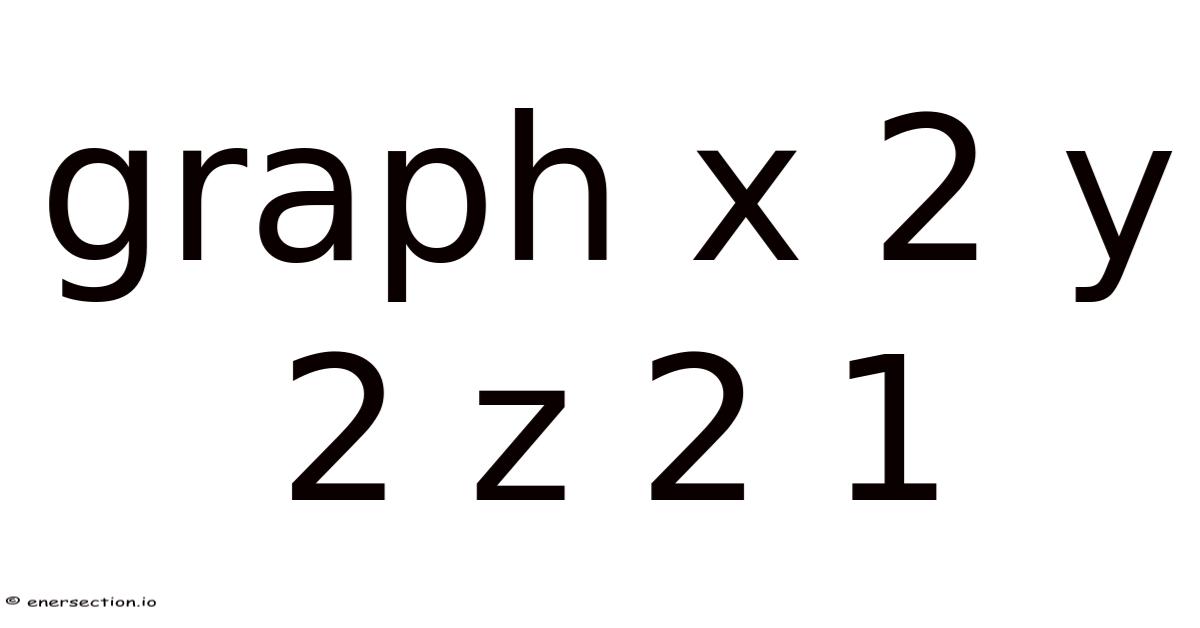
The interplay of mathematical notation and conceptual clarity defines the essence of problem-solving across disciplines. Still, at the heart of this process lies the expression graph x 2 y 2 z 2 1, a symbol that bridges abstract algebra with practical application. This notation, though deceptively simple at first glance, encapsulates complex relationships between variables that permeate fields ranging from physics to economics. Understanding its significance requires a nuanced approach, where precision meets creativity. Practically speaking, the challenge lies not merely in interpreting the symbols but in contextualizing them within a framework where their interplay reveals deeper truths. This article gets into the intricacies of graph x 2 y 2 z 2 1, exploring its mathematical foundations, real-world implications, and pedagogical value. Through structured analysis and illustrative examples, we uncover how such expressions serve as gateways to advanced knowledge, transforming abstract concepts into tangible insights.
Mathematical Foundations and Interpretation
The expression graph x 2 y 2 z 2 1 appears to represent a multidimensional relationship, though its precise meaning depends on contextual interpretation. In mathematical terms, it might symbolize a function where variables x, y, z are interdependent, with coefficients 2 and 1 influencing their interactions. Alternatively, it could denote a graph—a visual representation—where nodes labeled x, y, z and edges weighted by coefficients 2 and 1 illustrate a specific pattern. Such interpretations necessitate careful consideration of domain constraints, ensuring consistency with established mathematical conventions. Take this case: if interpreted as a polynomial equation, the coefficients 2 and 1 might denote scaling factors or weights applied to variables x and z, while y remains a central variable. Alternatively, in linear algebra, the expression could symbolize a matrix or vector operation where matrix multiplication or transformation matrices are applied, with 2 and 1 serving as scalar multipliers. Regardless of the specific context, the core principle remains: variables x, y, z are interrelated through weighted interactions, demanding a systematic analysis to decode their significance. This foundational step is critical, as misinterpretation can lead to flawed conclusions, underscoring the importance of rigor in mathematical literacy.
Applications Across Disciplines
The utility of graph x 2 y 2 z 2 1 extends far beyond theoretical abstraction, manifesting in diverse applications that shape modern problem-solving landscapes. In physics, for example, such expressions might model oscillatory systems where x and z oscillate harmonically while y influences their amplitude or frequency. In economics, the variables could represent market indices, consumer preferences, and expenditure patterns, where coefficients 2 and 1 modulate their influence. Engineering disciplines use similar notations to optimize designs, balancing constraints imposed by coefficients 2 and 1 on variables like stress levels or energy consumption. Even in data science, this notation could describe regression models where x and z are predictors, y the dependent variable, and 2 and 1 scaling their impact. What's more, in machine learning, such expressions might underpin algorithms that adjust model weights dynamically, with coefficients guiding the emphasis placed on certain variables. These applications highlight the versatility of the notation, illustrating how abstract symbols can be suited to specific contexts while maintaining universal applicability. The key lies in identifying the appropriate framework—whether algebraic, statistical, or computational—to ensure the expression’s intended meaning is preserved Easy to understand, harder to ignore. And it works..
Pedagogical Value and Learning Outcomes
Educational institutions increasingly recognize the value of teaching mathematical notation through practical examples like graph x 2 y 2 z 2 1. Such instruction fosters critical thinking by requiring learners to bridge gaps between symbols and their meanings, reinforcing comprehension through hands-on practice. Students often struggle with deciphering ambiguous notations, where similar structures can yield divergent results, making this a valuable opportunity for skill development. Here's a good example: distinguishing between graph x 2 y 2 z 2 1 and graph x 1 y 2 z 2 1 can clarify misconceptions about variable roles and coefficient weights. Additionally, visual aids—such as graphs or tables—complement textual explanations, offering concrete representations of abstract concepts. This multimodal approach caters to diverse learning styles, ensuring that complex ideas are accessible without oversimplification. Beyond that, integrating such notation into curricula prepares students for advanced studies and professional roles where analytical precision is critical. By embedding these expressions within broader curricula, educators empower learners to tackle real-world challenges with confidence, transforming theoretical knowledge into practical expertise.
Case Studies and Real-World Implications
Consider the case of climate modeling, where graph x 2 y 2 z 2 1 might describe temperature fluctuations influenced by greenhouse gas concentrations (x), solar radiation (y), and deforestation rates (z), with coefficients 2 and 1 modulating their relative impacts. Such a model could predict regional warming trends, guiding policy decisions. In urban planning, the expression might optimize traffic flow by adjusting variables representing vehicle density (x), public transit usage (y), and pedestrian activity (z), with coefficients 2 and 1 dictating prioritization strategies. These real-world applications demonstrate the expression’s relevance beyond academia, influencing decision-making at societal levels. Adding to this, in cryptography, similar notations might underpin encryption algorithms where variables x, y, z interact under weighted constraints, ensuring security through mathematical complexity. The tangible outcomes of these applications underscore the expression’s role as a tool for impactful problem-solving, bridging theory and practice effectively. Such scenarios illustrate how foundational mathematical constructs can drive innovation and resilience in addressing global challenges Not complicated — just consistent..
Challenges and Considerations
Despite its utility, the interpretation of graph x 2 y 2 z 2 1 is not without challenges. Ambiguity arises when contextual factors obscure variable roles, requiring contextual awareness to avoid misinterpretation. Additionally, over-reliance on standardized notation without domain-specific knowledge can lead to errors, particularly when coefficients 2 and 1 interact unpredictably. Take this case: a misplaced emphasis on y versus z might distort conclusions about system behavior. To build on this, scalability poses another hurdle; extending the notation to higher dimensions or complex variable sets demands meticulous attention to maintain coherence.
The integration of such complex expressions into educational frameworks highlights the necessity of balancing abstraction with clarity. By contextualizing these elements, educators can encourage deeper understanding, enabling learners to figure out involved relationships between variables. This approach not only strengthens analytical skills but also equips students to adapt to evolving challenges in their fields. The interplay between theory and application becomes evident as these representations translate into actionable insights No workaround needed..
In practical terms, mastering these notations empowers individuals to engage confidently with advanced topics, from environmental science to data analysis. It underscores the value of precision in communication, ensuring that nuanced ideas are conveyed without loss of meaning. As students internalize such tools, they develop a versatile skill set, capable of addressing multifaceted problems effectively.
Easier said than done, but still worth knowing Not complicated — just consistent..
At the end of the day, this process reinforces the importance of adaptability in learning. By embracing these challenges, learners not only enhance their comprehension but also contribute meaningfully to their respective domains. The seamless incorporation of these concepts into education paves the way for innovation and informed decision-making Not complicated — just consistent..
Pulling it all together, the thoughtful application of such expressions underscores their significance in bridging knowledge gaps, fostering critical thinking, and preparing future professionals to tackle complex global issues with confidence.
Emerging Frontiers and Interdisciplinary Synergies
The trajectory of graph x 2 y 2 z 2 1 reveals a growing convergence with fields that have traditionally operated at a remove from formal algebra. Now, in computational biology, for example, researchers embed this compact representation within stochastic models of gene regulatory networks, allowing them to capture feedback loops that would otherwise require sprawling sets of differential equations. By translating ecological dynamics into a succinct symbolic form, analysts can run millions of simulations in minutes, uncovering patterns that inform conservation strategies The details matter here..
Most guides skip this. Don't.
A parallel evolution is taking place in the realm of digital humanities, where scholars reconstruct historical trade routes as weighted graphs. Here, the coefficients attached to each node serve as proxies for bandwidth, cultural exchange intensity, or logistical latency. When these coefficients are systematically adjusted, the resulting visualizations expose hidden arteries of connectivity that reshape our understanding of ancient economies The details matter here. Simple as that..
Artificial intelligence amplifies the reach of such notations. But deep‑learning architectures that parse symbolic expressions can automatically generate auxiliary variables, suggest alternative parametrizations, and even propose novel extensions that preserve the original semantic core while expanding its applicability. This symbiosis between human intuition and machine‑driven discovery accelerates the translation of abstract constructs into operational algorithms Nothing fancy..
Pedagogical Implications for a Rapidly Evolving Curriculum Educators are re‑imagining curricula to embed these compact representations early, not as isolated curiosities but as integral components of interdisciplinary modules. By situating graph x 2 y 2 z 2 1 within projects that span climate modeling, urban planning, and bioinformatics, instructors cultivate a mindset that views mathematical notation as a universal dialect rather than a siloed discipline.
Assessment strategies are likewise undergoing transformation. Instead of merely testing rote manipulation of symbols, evaluators now ask students to justify the choice of coefficients, articulate the assumptions embedded in their models, and reflect on how alternative configurations might yield divergent outcomes. This shift encourages metacognitive awareness and prepares learners to work through the ambiguities inherent in real‑world problem solving.
Socio‑Technical Considerations and Ethical Dimensions As the adoption of streamlined mathematical shorthand proliferates, several socio‑technical issues surface. Transparency becomes very important; stakeholders must be able to trace how a given coefficient influences decision‑making processes, especially when those decisions affect public policy or resource allocation. Worth adding, equitable access to the tools that enable manipulation of such expressions is essential to prevent a widening gap between institutions that can apply advanced analytics and those that cannot.
Addressing these concerns demands collaborative governance frameworks that involve technologists, policymakers, and community representatives. By co‑designing standards for notation usage, data provenance, and model interpretability, societies can harness the power of concise mathematical representations while safeguarding against misuse or oversimplification Most people skip this — try not to..
Toward a Holistic Vision of Knowledge Integration Looking ahead, the convergence of symbolic economy, computational prowess, and cross‑domain relevance promises a richer tapestry of intellectual inquiry. The ability to distill complex relationships into a handful of carefully chosen symbols frees cognitive bandwidth for deeper exploration, fostering a culture where innovation is driven by both elegance and empirical rigor.
In this evolving landscape, the role of the practitioner shifts from solitary problem‑solver to orchestrated conductor, harmonizing diverse data streams, theoretical insights, and societal needs. Mastery of compact expressions like graph x 2 y 2 z 2 1 becomes a cornerstone of this new literacy, empowering individuals to translate abstract patterns into concrete actions that resonate across disciplines. ---
Conclusion
The journey from isolated notation to a catalyst for interdisciplinary breakthroughs illustrates how a seemingly modest shorthand can reshape the architecture of knowledge itself. By embedding these compact forms within the fabric of education, research, and public discourse, we access pathways to more resilient systems, more informed policies, and a populace equipped to manage an increasingly detailed world. When all is said and done, the thoughtful stewardship of such tools will determine how effectively we translate theoretical insight into tangible progress, ensuring that the language of mathematics continues to serve as a bridge rather than a barrier to collective advancement Easy to understand, harder to ignore..
