Introduction
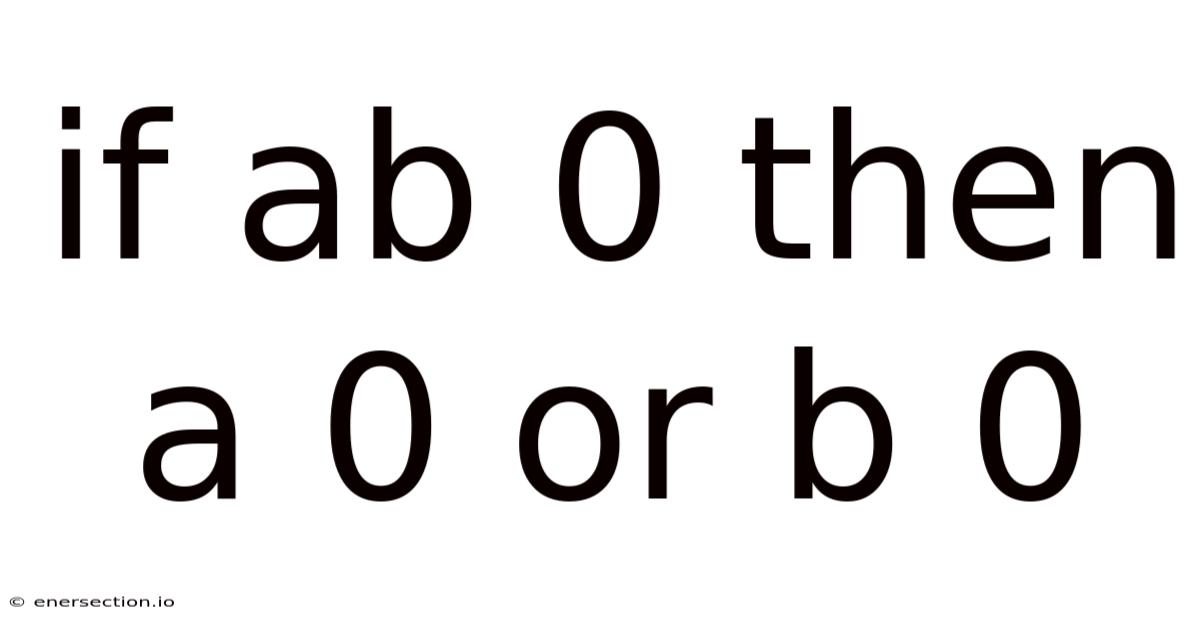
The statement “if (ab = 0) then (a = 0) or (b = 0)” is a cornerstone of elementary algebra and appears in virtually every high‑school mathematics curriculum. Now, it encapsulates the zero‑product property, a rule that allows us to solve equations, factor polynomials, and prove more advanced results in calculus and linear algebra. Understanding why the property holds, when it can be applied, and what its limitations are is essential for anyone who wants to move beyond rote computation to genuine mathematical reasoning.
In this article we will:
- Define the zero‑product property formally.
- Prove the implication using several approaches (direct proof, contrapositive, and proof by contradiction).
- Explore the role of the underlying number system (integers, rationals, real numbers, complex numbers, and rings).
- Show how the property is used in solving equations, factoring expressions, and proving the Fundamental Theorem of Algebra.
- Address common misconceptions and answer frequently asked questions.
By the end of the reading, you should be able to apply the zero‑product property confidently, explain why it works, and recognize situations where a more careful analysis is required Took long enough..
1. Formal Statement and Basic Proof
1.1 Statement
Zero‑Product Property
For any two elements (a) and (b) in a field (e.g., (\mathbb{Z}, \mathbb{Q}, \mathbb{R}, \mathbb{C})),
[ ab = 0 ;\Longrightarrow; a = 0 ;\text{or}; b = 0 .
The logical connector “or” is inclusive: it is possible that both (a) and (b) are zero simultaneously.
1.2 Direct Proof (Using Multiplicative Inverses)
Fields have the crucial property that every non‑zero element possesses a multiplicative inverse. Suppose (ab = 0) and assume, for contradiction, that both (a) and (b) are non‑zero.
- Because (a \neq 0), there exists an element (a^{-1}) such that (a^{-1}a = 1).
- Multiply both sides of (ab = 0) by (a^{-1}) on the left: [ a^{-1}(ab) = a^{-1}0 \quad\Longrightarrow\quad (a^{-1}a)b = 0 \quad\Longrightarrow\quad 1\cdot b = 0 . ]
- This simplifies to (b = 0), contradicting the assumption that (b \neq 0).
Thus at least one of the factors must be zero. The same reasoning works if we start by assuming (b \neq 0) and multiply by (b^{-1}) on the right.
1.3 Proof via Contrapositive
The contrapositive of the original implication is logically equivalent:
[ a \neq 0 ;\text{and}; b \neq 0 ;\Longrightarrow; ab \neq 0 . ]
In a field, the product of two non‑zero elements is non‑zero because the multiplication operation is closed and cancellable. And if (a\neq0) and (b\neq0), then both have inverses, and the product (ab) also has an inverse ((ab)^{-1}=b^{-1}a^{-1}). Since an element with an inverse cannot be zero, we obtain (ab\neq0). This establishes the original statement indirectly Nothing fancy..
1.4 Proof by Contradiction
Assume the negation of the conclusion: both (a\neq0) and (b\neq0). From the hypothesis (ab=0) we would have a non‑zero element multiplied by another non‑zero element yielding zero, which is impossible in a field. The contradiction forces us to reject the assumption, leaving the only viable possibilities: (a=0) or (b=0) Surprisingly effective..
2. Why the Property Holds in Some Structures but Not Others
2.1 Fields vs. Rings
A field (e.In real terms, g. , (\mathbb{R}, \mathbb{C})) guarantees the existence of multiplicative inverses for every non‑zero element, making the zero‑product property universally true Small thing, real impact..
A ring may lack inverses for non‑zero elements. In many rings the property still holds (e.Now, g. , the ring of integers (\mathbb{Z})), but there are zero‑divisors—non‑zero elements whose product is zero Small thing, real impact..
[ 2 \times 3 \equiv 0 \pmod{6}, ]
yet (2\neq0) and (3\neq0) in (\mathbb{Z}_6). Here the zero‑product property fails because the structure contains zero‑divisors It's one of those things that adds up..
2.2 Integral Domains
An integral domain is a commutative ring with unity and no zero‑divisors. By definition, the zero‑product property holds in every integral domain. The integers (\mathbb{Z}), the polynomial ring (\mathbb{R}[x]), and the Gaussian integers (\mathbb{Z}[i]) are classic examples Still holds up..
2.3 Practical Takeaway
When solving equations in familiar number systems (real, rational, complex), you can safely use the zero‑product property. In more abstract algebraic settings, always verify whether the underlying structure is an integral domain before applying it That alone is useful..
3. Applications in Solving Equations
3.1 Linear and Quadratic Equations
The most common use appears when factoring a polynomial and setting it equal to zero:
[ (x-2)(x+5) = 0 \quad\Longrightarrow\quad x-2 = 0 ;\text{or}; x+5 = 0, ]
yielding the solutions (x=2) and (x=-5). The reasoning hinges directly on the zero‑product property.
3.2 Higher‑Degree Polynomials
For a cubic (p(x) = (x-1)(x^2+4x+4) = (x-1)(x+2)^2), the equation (p(x)=0) splits into:
[ x-1 = 0 ;\text{or}; (x+2)^2 = 0. ]
Since ((x+2)^2 = 0) implies (x+2 = 0), we obtain the root (-2) with multiplicity two, plus the root (1). The property simplifies the process of extracting all real or complex roots.
3.3 Systems of Equations
In a system such as
[ \begin{cases} xy = 0,\ x + y = 5, \end{cases} ]
the first equation tells us (x=0) or (y=0). Substituting each possibility into the second equation yields the two solution pairs ((0,5)) and ((5,0)). Without the zero‑product property, we would need a more cumbersome case analysis.
3.4 Inequalities and Absolute Values
When solving (|ab| = 0), the absolute value function is non‑negative and equals zero iff its argument is zero. Thus (|ab|=0) forces (ab=0), and the zero‑product property again gives the two possibilities.
4. Deeper Connections
4.1 Fundamental Theorem of Algebra
The theorem states that every non‑constant polynomial with complex coefficients has at least one complex root. The proof frequently uses the fact that a polynomial of degree (n) can be factored as
[ p(z) = (z - r_1)(z - r_2)\dots(z - r_n), ]
where each factor corresponds to a root (r_i). The step from “(p(z)=0)” to “one of the factors is zero” is an application of the zero‑product property in (\mathbb{C}).
4.2 Linear Algebra – Determinants
For a (2\times2) matrix (A = \begin{pmatrix}a & b \ c & d\end{pmatrix}), the determinant is (\det(A)=ad-bc). If (\det(A)=0), the matrix is singular, meaning its rows (or columns) are linearly dependent. Consider this: in the special case where the matrix is diagonal, (\det(A)=ad). Then (ad=0) implies (a=0) or (d=0), directly using the zero‑product property to identify a zero eigenvalue.
No fluff here — just what actually works.
4.3 Calculus – Critical Points
Consider the derivative of a product: ((fg)' = f'g + fg'). Setting the derivative to zero for critical points yields
[ f'g + fg' = 0 ;\Longrightarrow; f'g = -fg'. ]
If we can factor a common term, say (f) or (g), we may arrive at a product equal to zero and apply the property to locate stationary points.
5. Common Misconceptions
| Misconception | Clarification |
|---|---|
| “If (ab = 0) then both (a) and (b) must be zero.On top of that, ” | It fails in rings with zero‑divisors (e. This leads to |
| **“The property works in any algebraic structure. But example: (0 \times 5 = 0). Still, | |
| **“(a = 0) or (b = 0) means exactly one of them is zero. Which means g. | |
| “If (a^2 = 0) then (a = 0) only because of the zero‑product property.” | The statement is false; only at least one factor needs to be zero. ”** |
6. Frequently Asked Questions
6.1 Does the property hold for vectors?
If vectors are multiplied using the dot product, the result is a scalar. The equation (\mathbf{u}\cdot\mathbf{v}=0) does not imply (\mathbf{u}=0) or (\mathbf{v}=0); it only tells us the vectors are orthogonal. The zero‑product property is specific to multiplication in a field, not to other bilinear operations.
6.2 What about matrices?
Matrix multiplication is not commutative, but it still satisfies the zero‑product property in the sense that if (AB = 0) (zero matrix), it does not necessarily imply (A = 0) or (B = 0). Counterexample:
[ A = \begin{pmatrix}1 & 0 \ 0 & 0\end{pmatrix},\quad B = \begin{pmatrix}0 & 1 \ 0 & 0\end{pmatrix},\quad AB = 0. ]
Thus the property fails for general matrix rings because they contain zero‑divisors.
6.3 Can we use the property with inequalities?
If (ab \le 0) we cannot directly conclude (a \le 0) or (b \le 0); the sign of a product depends on the signs of both factors. The zero‑product property is an equality statement only.
6.4 How does the property relate to solving absolute value equations?
Going back to this, (|x| = 0) iff (x = 0). Therefore an equation like (|ab| = 0) reduces to (ab = 0), after which the zero‑product property gives the two possibilities for (a) and (b).
6.5 Is there a version for more than two factors?
Yes. By induction, if (a_1a_2\cdots a_n = 0) in a field, then at least one of the factors (a_i) must be zero. The proof proceeds by repeatedly applying the two‑factor case.
7. Step‑by‑Step Example: Solving a Real‑World Problem
Problem: A rectangular garden has length (L) meters and width (W) meters. The area is given by (A = L \times W). If the area is zero, what can be said about the dimensions?
Solution:
- Write the condition: (LW = 0).
- Apply the zero‑product property: either (L = 0) or (W = 0).
- Interpret: The garden collapses to a line segment (width zero) or to a point (both dimensions zero).
This simple reasoning illustrates how the property translates abstract algebra into tangible conclusions.
8. Summary
The implication “if (ab = 0) then (a = 0) or (b = 0)” is not merely a memorized rule; it follows from the fundamental structure of fields and integral domains. Now, by leveraging multiplicative inverses, the contrapositive, or proof by contradiction, we see that a product can be zero only when at least one factor vanishes. The property underpins the solution of polynomial equations, the factorization of expressions, and many proofs across algebra, calculus, and linear algebra But it adds up..
Remember:
- Fields → property always true.
- Rings with zero‑divisors → property may fail.
- Inclusive “or” means both factors can be zero simultaneously.
Armed with this understanding, you can approach algebraic problems with confidence, knowing exactly when the zero‑product property is a reliable tool and when a deeper investigation of the underlying algebraic structure is required Simple as that..
