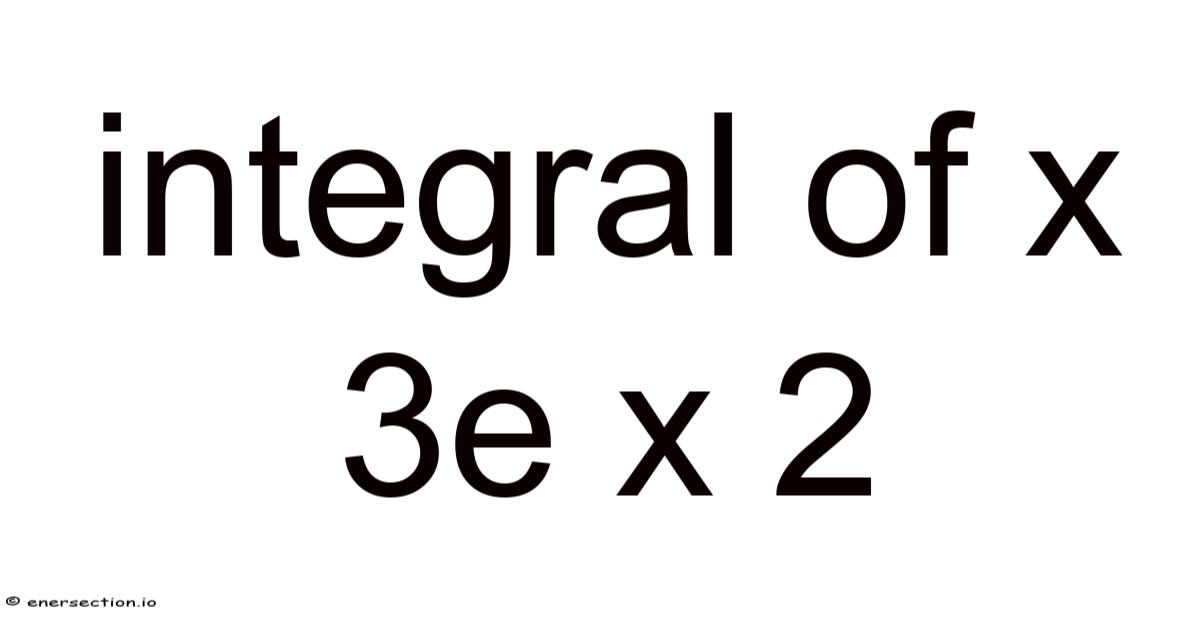
Understanding the Integral of x³e^(x²)
Calculating the integral of x³e^(x²) is a classic challenge in calculus that requires a strategic approach. While it may look intimidating at first glance due to the combination of a polynomial and an exponential function, this specific problem is a perfect example of how integration by substitution and integration by parts can be combined to simplify a complex expression. Whether you are a student preparing for an exam or a lifelong learner refreshing your mathematical skills, mastering this integral provides deep insight into the relationship between different integration techniques.
And yeah — that's actually more nuanced than it sounds.
Introduction to the Problem
In calculus, integration is essentially the process of finding the antiderivative of a function. When we encounter the expression $\int x^3 e^{x^2} dx$, we are looking for a function whose derivative is $x^3 e^{x^2}$.
At first sight, this does not fit a standard basic integration formula. It is not a simple power rule problem, nor is it a basic exponential integral. The "trick" lies in recognizing the relationship between the exponent ($x^2$) and the coefficient ($x^3$). Since the derivative of $x^2$ is $2x$, and we have an $x^3$ term (which can be split into $x^2 \cdot x$), we have a clear path toward using a substitution that will simplify the exponent And that's really what it comes down to..
It sounds simple, but the gap is usually here.
Step-by-Step Solution
To solve $\int x^3 e^{x^2} dx$, we must break the process down into manageable phases. We cannot solve it in one single step; instead, we use a two-stage strategy.
Step 1: The First Substitution (u-substitution)
The most difficult part of this integral is the $e^{x^2}$ term. To make this easier, we want to replace the exponent with a single variable.
- Let $u = x^2$.
- Now, find the derivative of $u$ with respect to $x$: $\frac{du}{dx} = 2x$, which means $du = 2x dx$ or $dx = \frac{du}{2x}$.
- Now, let's look at our original integral: $\int x^3 e^{x^2} dx$.
- We can rewrite $x^3$ as $x^2 \cdot x$. This allows us to substitute $x^2$ with $u$: $\int (x^2) \cdot e^{x^2} \cdot (x dx)$
- Substitute $u$ for $x^2$ and $\frac{du}{2}$ for $x dx$: $\int u \cdot e^u \cdot \frac{1}{2} du$
- Pull the constant $1/2$ outside the integral: $\frac{1}{2} \int u e^u du$
By performing this substitution, we have transformed a complex expression into a much simpler one: the integral of a product of a linear term ($u$) and an exponential term ($e^u$) Not complicated — just consistent..
Step 2: Integration by Parts
Now we face the integral $\int u e^u du$. This is a textbook case for Integration by Parts, which is based on the formula: $\int w dv = wv - \int v dw$
We need to choose our $w$ and $dv$ wisely. The goal is to pick a $w$ that becomes simpler when differentiated and a $dv$ that is easy to integrate.
- Let $w = u$ $\implies$ $dw = du$
- Let $dv = e^u du$ $\implies$ $v = e^u$
Applying the formula: $\int u e^u du = (u)(e^u) - \int e^u du$
Now, integrate the remaining term: $\int u e^u du = u e^u - e^u + C$
Step 3: Combining and Back-Substituting
Now that we have solved the inner integral, we must bring back the constant we pulled out earlier and return to our original variable, $x$.
- Recall the expression from Step 1: $\frac{1}{2} \int u e^u du$.
- Plug in the result from Step 2: $\frac{1}{2} (u e^u - e^u) + C$
- Factor out $e^u$: $\frac{1}{2} e^u (u - 1) + C$
- Finally, replace $u$ with the original substitution $u = x^2$: $\frac{1}{2} e^{x^2} (x^2 - 1) + C$
Final Answer: $\int x^3 e^{x^2} dx = \frac{1}{2} e^{x^2}(x^2 - 1) + C$
Scientific and Mathematical Explanation
Why does this method work? The core logic here is the Chain Rule in reverse It's one of those things that adds up..
The $x^3$ term acts as a "catalyst." In many integration problems, you need a specific derivative present to perform a substitution. Here's the thing — because the derivative of $x^2$ is $2x$, the presence of at least one $x$ multiplier is mandatory to clear the $dx$. The remaining $x^2$ (from the $x^3$) then becomes the new variable $u$.
The use of Integration by Parts is necessary because we are dealing with a product of two different types of functions (algebraic and exponential). The process of "parts" effectively shifts the derivative from the algebraic term to the exponential term. Since the derivative of $e^u$ is simply $e^u$, the integral converges quickly Turns out it matters..
Common Mistakes to Avoid
When solving this specific integral, students often encounter a few common pitfalls:
- Forgetting the $1/2$ constant: Many forget that $du = 2x dx$, meaning they forget to divide by 2. This leads to an answer that is off by a factor of two.
- Incorrect Substitution: Trying to set $u = x^3$ or $u = e^{x^2}$ usually leads to a dead end or an even more complicated expression. Always look for the "inner function" (the exponent) first.
- Neglecting the Constant of Integration ($C$): In indefinite integrals, the $+ C$ is essential because any constant would disappear during differentiation.
FAQ: Frequently Asked Questions
What is the difference between this and $\int x e^{x^2} dx$?
The integral $\int x e^{x^2} dx$ is much simpler. It only requires a basic substitution ($u = x^2$), resulting in $\frac{1}{2} e^{x^2} + C$. The $x^3$ in our original problem adds an extra layer of complexity, requiring the additional step of Integration by Parts Not complicated — just consistent..
Can this be solved using only substitution?
No. A single substitution can simplify the exponent, but it cannot eliminate the product of $u$ and $e^u$. You must use Integration by Parts or a similar technique to handle the product of the two functions It's one of those things that adds up..
What happens if the power of $x$ is higher, like $\int x^5 e^{x^2} dx$?
The process is similar! You would substitute $u = x^2$, which would leave you with $\frac{1}{2} \int u^2 e^u du$. You would then need to perform Integration by Parts twice to gradually reduce $u^2$ to $u$ and then to a constant.
Conclusion
Solving the integral of $x^3 e^{x^2}$ is a rewarding exercise that demonstrates the synergy between substitution and integration by parts. By recognizing that $x^3$ can be split into $x^2 \cdot x$, we get to the ability to simplify the exponent, turning a daunting problem into a manageable one.
The final result, $\frac{1}{2} e^{x^2}(x^2 - 1) + C$, represents the area under the curve of the function $f(x) = x^3 e^{x^2}$. Mastering these steps not only helps in passing calculus exams but also builds the analytical thinking required for physics, engineering, and advanced data science, where these types of growth-decay functions are frequently encountered.
Such integrals underscore the interplay between structure and complexity, offering insights vital for modeling dynamic systems across disciplines. Their mastery bridges theoretical rigor with practical application, refining analytical precision and fostering adaptability in tackling multifaceted challenges.
Continuing without friction from the existing conclusion, the solution to ( \int x^3 e^{x^2} dx ) exemplifies a fundamental principle in calculus: strategic decomposition. Think about it: by recognizing that ( x^3 ) could be split into ( x^2 \cdot x ), we transformed the integral into a form where substitution (( u = x^2 )) and integration by parts could collaborate effectively. This layered approach—simplifying the exponent first, then resolving the remaining product—is a powerful template for tackling integrals involving polynomial-exponential products.
Not obvious, but once you see it — you'll see it everywhere.
The elegance of this solution lies in its modularity. g.Practically speaking, , modeling damped oscillators) and probability (e. And g. This modular strategy extends to higher powers of ( x ), as noted in the FAQ, where repeated applications of integration by parts systematically reduce the polynomial degree. Worth adding: such techniques are not merely academic tools; they form the backbone of solving differential equations in physics (e. The substitution ( u = x^2 ) reduces the problem to ( \frac{1}{2} \int u e^u du ), which is a standard integration-by-parts case. , moment-generating functions in statistics).
Also worth noting, this integral underscores a deeper conceptual insight: the interplay between algebraic manipulation and calculus operations. The act of rewriting ( x^3 ) as ( x^2 \cdot x ) is algebraic, while integration by parts is calculus-driven. Their synergy reveals how pre-calculus algebra shapes calculus solutions—a critical realization for advancing into multivariable calculus or vector calculus.
In practical terms, mastering this process builds mathematical maturity. It trains students to:
- Still, Identify structural patterns (e. g.Consider this: , recognizing when a product requires decomposition). Think about it: 2. Worth adding: Combine techniques fluidly (substitution followed by integration by parts). 3. Anticipate complexity (knowing higher powers demand iterative steps).
Beyond exams, these skills are indispensable in fields like computational biology (modeling reaction kinetics) and machine learning (solving integrals in Bayesian inference). The integral ( \int x^3 e^{x^2} dx ) thus becomes a microcosm of how calculus bridges abstract theory and real-world complexity.
Final Reflection
The solution ( \frac{1}{2} e^{x^2}(x^2 - 1) + C ) is more than an answer—it is a testament to the creative logic embedded in calculus. It shows that even intimidating integrals yield to structured thinking, where each step (substitution, decomposition, integration by parts) builds upon the last. This problem, in particular, highlights that growth and decay functions—ubiquitous in science—often require hybrid methods, blending substitution to simplify exponents and integration by parts to resolve polynomial terms.
At the end of the day, the journey through ( \int x^3 e^{x^2} dx ) reinforces a universal truth in mathematics: complexity is often reducible through strategic simplification. By mastering this interplay of techniques, students gain not just computational proficiency, but a lens to dissect involved systems—whether modeling neural networks, optimizing engineering designs, or analyzing economic trends. The integral becomes a gateway, demonstrating how calculus transforms chaos into clarity.
