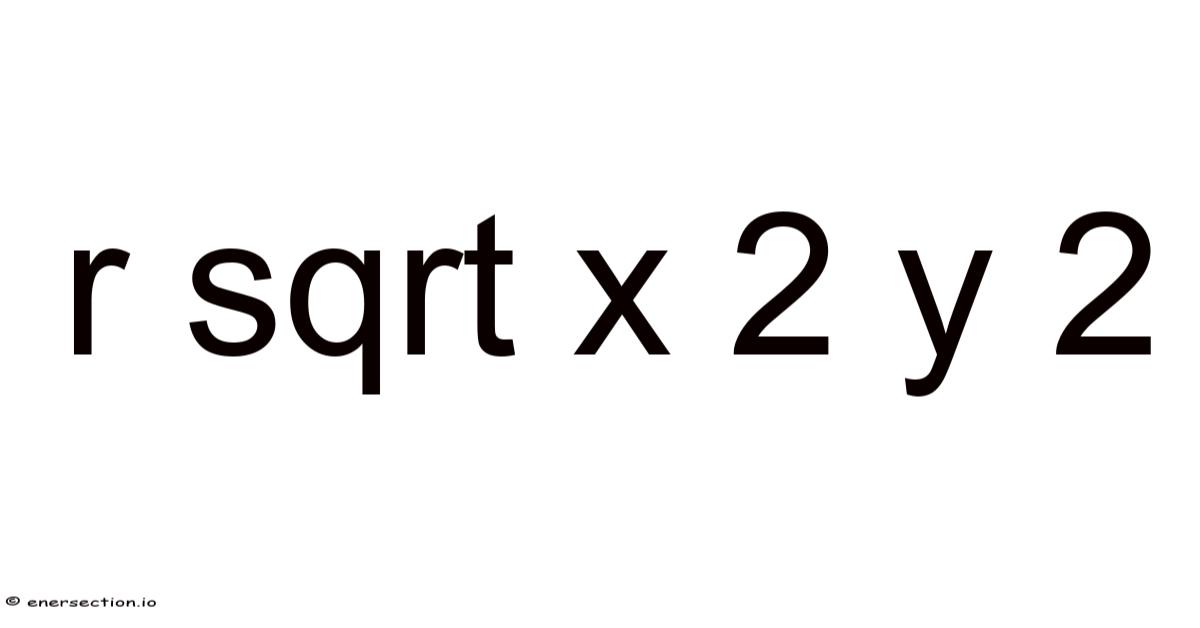
Understanding the Formula r = √(x² + y²): A Guide to Polar Coordinates and Distance Calculations
The expression r = √(x² + y²) is a fundamental formula in mathematics, particularly in coordinate geometry and polar coordinate systems. It calculates the radial distance from the origin (0,0) to a point (x, y) in a two-dimensional Cartesian plane. This formula is derived from the Pythagorean theorem and serves as the bridge between Cartesian coordinates (x, y) and polar coordinates (r, θ), where r represents the radius and θ the angle. Whether you're solving physics problems, navigating maps, or designing computer graphics, understanding this formula is essential for converting between coordinate systems and calculating distances efficiently.
Derivation of the Formula
The formula r = √(x² + y²) originates from the Pythagorean theorem, which states that in a right-angled triangle, the square of the hypotenuse (the side opposite the right angle) is equal to the sum of the squares of the other two sides That's the part that actually makes a difference. No workaround needed..
Imagine a point P(x, y) plotted on a Cartesian plane. Drawing a line from the origin (0, 0) to P forms the hypotenuse of a right triangle. The horizontal leg of the triangle has length x, and the vertical leg has length y.
r² = x² + y²
Taking the square root of both sides gives:
r = √(x² + y²)
This formula calculates the straight-line distance from the origin to the point (x, y), making it a cornerstone of coordinate geometry.
Step-by-Step Calculation Example
Let’s walk through a practical example to solidify the concept. Suppose we want to find the radial distance r for the point (3, 4):
-
Square the x and y values:
- x² = 3² = 9
- y² = 4² = 16
-
Add the squared values:
- 9 + 16 = 25
-
Take the square root:
- √25 = 5
Thus, r = 5. This result tells us that the point (3, 4) lies 5 units away from the origin. This example also illustrates the famous 3-4-5 Pythagorean triple, a common integer solution to the theorem.
Applications of the Formula
The formula r = √(x² + y²) is widely used across disciplines:
-
Physics and Engineering:
- Calculating the magnitude of vectors, such as velocity or force, in two dimensions.
- Determining the distance between two points in mechanical systems or structural analysis.
-
Computer Graphics:
- Converting Cartesian coordinates to polar coordinates for rendering circular or radial patterns.
- Calculating distances between pixels or objects in 2D space.
-
Navigation and Geography:
- Finding the shortest path between two points on a map using latitude and longitude coordinates.
- GPS systems use similar principles to compute distances between locations.
-
Mathematics and Trigonometry:
- Converting between Cartesian and polar coordinate systems, where r is paired with an angle θ to describe a point’s position.
Common Mistakes and Tips
While the formula seems straightforward, students often make these errors:
- Forgetting to square the coordinates: Always square x and y before adding them. Skipping this step leads to incorrect results.
- Misapplying the square root: Ensure the square root applies to the entire sum of x² + y², not just one term.
- Confusing with 3D distance: In three dimensions, the formula extends to r = √(x² + y² + z²).
Tips for Success:
- Always visualize the problem by sketching the point on a Cartesian plane.
- Double-check calculations, especially when dealing with negative coordinates (squaring removes the negative sign).
- Use calculators or software for complex numbers, but understand the manual process for foundational knowledge.
FAQ About r = √(x² + y²)
Q: Why is this formula important?
A: It allows us to convert Cartesian coordinates to polar coordinates, simplifying problems involving circles, angles, and radial symmetry. It’s also the basis for calculating Euclidean distances in 2D space.
Q: How does this differ from the distance formula between two points?
A: The distance formula between two points (x₁, y₁) and (x₂, y₂) is d = √[(x₂ – x₁)² + (y₂ – y₁)²]. The formula r = √(x² + y²) specifically calculates the distance from the origin to a single point Simple, but easy to overlook. Which is the point..
Q: Can this formula be extended to 3D?
A: Yes! In three dimensions, the formula becomes r = √(x² + y² + z²) to calculate the distance from the
The utility of r = √(x² + y²) extends far beyond theoretical mathematics, offering practical solutions in diverse fields. Whether analyzing physical phenomena, optimizing computational models, or solving real-world navigation challenges, this formula remains a cornerstone of problem-solving. By understanding its applications and avoiding common pitfalls, learners can harness its power effectively That alone is useful..
In essence, mastering this concept bridges abstract theory with tangible outcomes, empowering individuals to tackle complex scenarios with confidence. Its versatility underscores the importance of continuous practice and critical thinking in applying mathematical principles.
Conclusion: The significance of the formula lies not only in its calculation but in its ability to simplify and clarify challenges across disciplines. Embracing its relevance ensures a deeper appreciation of how mathematics shapes our understanding of the world.
origin to a point in three-dimensional space, which is essential in fields like engineering and physics for calculating distances in 3D models.
Beyond mathematics, this formula plays a critical role in practical applications. In physics, it helps determine the magnitude of vectors, such as velocity or force, when resolving components. Because of that, engineers use it to calculate structural loads and distances in design projects. In practice, in computer graphics, the formula is foundational for rendering 3D environments and calculating lighting effects. Even GPS technology relies on similar distance calculations to pinpoint locations on Earth.
Understanding r = √(x² + y²) is not just about memorizing a formula—it’s about recognizing patterns in space and quantifying relationships between points. Whether you’re analyzing data, designing a roller coaster, or simply calculating the shortest path between two locations, this concept provides a reliable framework Most people skip this — try not to..
All in all, the formula r = √(x² + y²) is more than a mathematical tool; it is a gateway to understanding spatial relationships and solving problems across disciplines. By mastering its use and avoiding common errors, learners can reach a deeper appreciation for how mathematics connects theory to the world around us Less friction, more output..
The formula remains important in bridging abstract mathematics with practical applications, underscoring its enduring relevance in shaping our understanding of spatial relationships. Its application spans disciplines, offering clarity and precision that transcend theoretical boundaries. Such insights cement its status as a cornerstone of modern problem-solving Surprisingly effective..
The formula r = √(x² + y²) also serves as a foundational element in trigonometry and vector analysis, where it forms the basis for polar coordinates and vector magnitude calculations. Because of that, in education, it is often one of the first introductions to the Pythagorean theorem, helping students transition from basic geometry to more advanced mathematical reasoning. Its simplicity belies its power—when applied correctly, it eliminates ambiguity in spatial calculations, making it indispensable in fields like robotics, where precise movement and positioning are critical Easy to understand, harder to ignore..
Still, its effectiveness depends on proper application. Here's the thing — common errors include misidentifying coordinates, especially in multi-dimensional contexts, or forgetting to square the values before summing them. And additionally, learners often overlook the importance of units, leading to inconsistencies in real-world measurements. Addressing these pitfalls through practice and attention to detail ensures accurate results Easy to understand, harder to ignore..
As technology advances, the formula’s relevance persists. From machine learning algorithms calculating Euclidean distances in data clustering to architects designing structures with precise measurements, r = √(x² + y²) remains a timeless tool. Its enduring presence in both classical and modern applications highlights the universal nature of mathematical principles Less friction, more output..
So, to summarize, the formula r = √(x² + y²) is more than a simple equation—it is a gateway to understanding spatial relationships and solving complex problems. By mastering its use and avoiding common mistakes, individuals can open up a deeper appreciation for how mathematics shapes our understanding of the world. Its versatility and reliability ensure its place as a cornerstone of modern problem-solving Nothing fancy..
