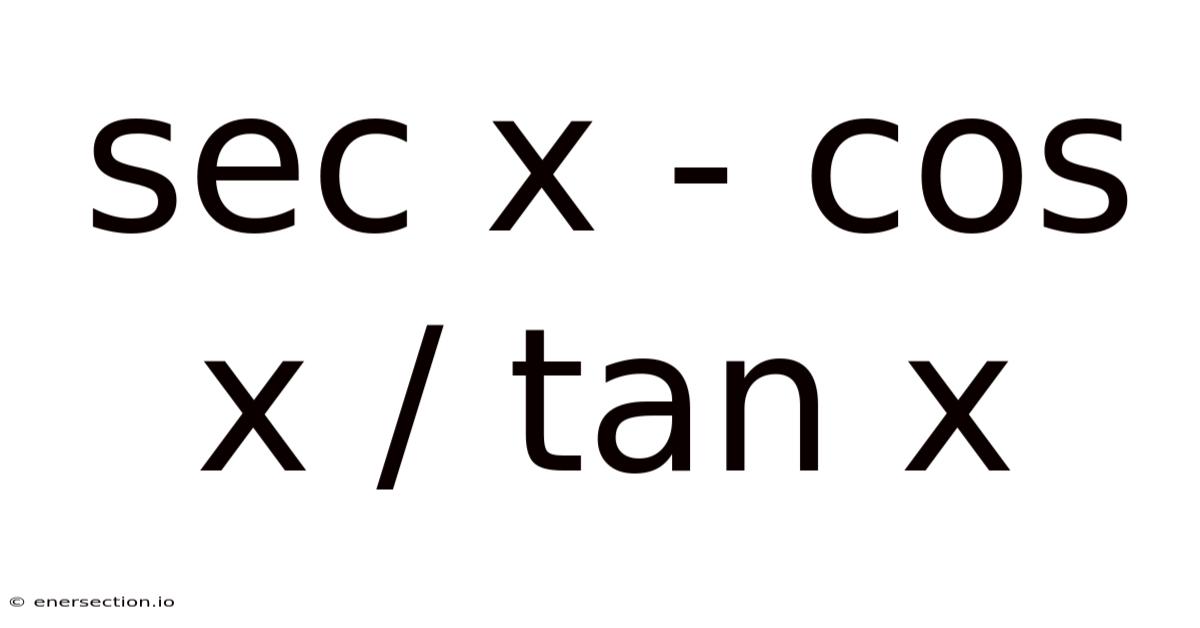
Understanding the Trigonometric Identity: Simplifying sec x - cos x / tan x
Simplifying the trigonometric expression sec x - cos x / tan x is a fundamental exercise in trigonometry that helps students master the relationships between various trigonometric functions. Whether you are preparing for a calculus exam or simply trying to strengthen your algebraic manipulation skills, understanding how to reduce complex trigonometric fractions into simpler forms is essential. This article will provide a step-by-step mathematical breakdown, explain the underlying identities, and offer practical tips to solve similar problems with ease.
Introduction to Trigonometric Simplification
Trigonometry can often feel like a labyrinth of symbols and functions. Plus, you encounter secant (sec), cosine (cos), tangent (tan), sine (sin), cosecant (csc), and cotangent (cot). While they may seem distinct, they are all deeply interconnected through a set of fundamental identities.
The expression we are analyzing today, $\frac{\sec x - \cos x}{\tan x}$, looks intimidating at first glance because it involves three different trigonometric ratios. Even so, the secret to solving almost any trigonometric simplification problem is to convert everything into terms of sine and cosine. By doing this, you transform a multi-variable problem into a single-variable algebraic fraction that can be simplified using standard rules of arithmetic.
The Core Identities You Need to Know
Before we dive into the step-by-step solution, let's review the "toolbox" of identities required to solve this specific problem. If you memorize these, you will find that trigonometry becomes much more intuitive.
- Reciprocal Identities:
- $\sec x = \frac{1}{\cos x}$ (Secant is the reciprocal of cosine)
- $\csc x = \frac{1}{\sin x}$ (Cosecant is the reciprocal of sine)
- Quotient Identities:
- $\tan x = \frac{\sin x}{\cos x}$ (Tangent is the ratio of sine to cosine)
- Pythagorean Identity:
- $\sin^2 x + \cos^2 x = 1$
- From this, we can derive: $1 - \cos^2 x = \sin^2 x$
Step-by-Step Mathematical Derivation
To simplify $\frac{\sec x - \cos x}{\tan x}$, we will follow a logical progression. Let's break it down into manageable stages.
Step 1: Convert all terms to Sine and Cosine
The first rule of thumb in trigonometry is: When in doubt, convert to $\sin x$ and $\cos x$.
The numerator contains $\sec x$, which we know is $\frac{1}{\cos x}$. The denominator contains $\tan x$, which we know is $\frac{\sin x}{\cos x}$ Easy to understand, harder to ignore. Took long enough..
So, our expression becomes: $\frac{\frac{1}{\cos x} - \cos x}{\frac{\sin x}{\cos x}}$
Step 2: Simplify the Numerator
The numerator is currently a subtraction of a fraction and a whole term: $\frac{1}{\cos x} - \cos x$. To subtract these, we need a common denominator. We can treat $\cos x$ as $\frac{\cos x}{1}$ Turns out it matters..
To get a common denominator of $\cos x$, we multiply the second term by $\frac{\cos x}{\cos x}$: $\frac{1}{\cos x} - \frac{\cos^2 x}{\cos x} = \frac{1 - \cos^2 x}{\cos x}$
Now, our entire complex fraction looks like this: $\frac{\frac{1 - \cos^2 x}{\cos x}}{\frac{\sin x}{\cos x}}$
Step 3: Apply the Pythagorean Identity
Looking at the numerator we just created, $\frac{1 - \cos^2 x}{\cos x}$, we see a very familiar pattern: $1 - \cos^2 x$. According to the Pythagorean Identity, $1 - \cos^2 x = \sin^2 x$.
Let's substitute this into our expression: $\frac{\frac{\sin^2 x}{\cos x}}{\frac{\sin x}{\cos x}}$
Step 4: Simplify the Complex Fraction
We are now dividing one fraction by another fraction. The rule for dividing fractions is to multiply the first fraction by the reciprocal of the second fraction (often referred to as "Keep, Change, Flip") But it adds up..
$\frac{\sin^2 x}{\cos x} \times \frac{\cos x}{\sin x}$
Step 5: Final Cancellation
Now, we look for terms that appear in both the numerator and the denominator to cancel them out:
- The $\cos x$ in the numerator cancels out the $\cos x$ in the denominator.
- One $\sin x$ in the denominator cancels out one of the $\sin x$ terms in the $\sin^2 x$ (which is $\sin x \cdot \sin x$) in the numerator.
Worth pausing on this one Less friction, more output..
What remains is: $\frac{\sin^2 x}{\sin x} = \sin x$
Final Result: The expression $\frac{\sec x - \cos x}{\tan x}$ simplifies beautifully to $\sin x$ Practical, not theoretical..
Scientific and Mathematical Explanation
Why does this work? The beauty of trigonometry lies in the circular nature of the functions. All trigonometric functions are derived from the coordinates of a point moving around a unit circle The details matter here..
When we simplify $\sec x - \cos x$, we are essentially looking at the difference between the reciprocal of the x-coordinate and the x-coordinate itself. This difference, when scaled by the tangent (the slope of the terminal side), collapses back into the y-coordinate of the point, which is defined as $\sin x$.
Not the most exciting part, but easily the most useful Not complicated — just consistent..
This process demonstrates the consistency of trigonometric ratios. No matter how complex an expression looks, it is ultimately just a different way of describing the geometric relationships between the sides of a right-angled triangle or the coordinates on a unit circle And it works..
Common Pitfalls to Avoid
When students attempt to solve this, they often make a few common mistakes. Being aware of these will help you avoid losing marks in exams:
- Incorrect Reciprocals: A very common error is confusing $\sec x$ with $\csc x$. Remember: Secant goes with Cosine, and Cosecant goes with Sine.
- Neglecting the Common Denominator: Many students try to subtract $\cos x$ from $\frac{1}{\cos x}$ by simply writing $\frac{1 - \cos x}{\cos x}$. This is algebraically incorrect. You must always find a common denominator when subtracting fractions.
- Forgetting the Pythagorean Identity: Some students get stuck at the $\frac{1 - \cos^2 x}{\cos x}$ stage. Always look for the $1 - \sin^2 x$ or $1 - \cos^2 x$ patterns; they are the "keys" that open up most trigonometric simplifications.
- Improper Fraction Division: Remember that $\frac{A/B}{C/D}$ is $ \frac{A}{B} \cdot \frac{D}{C}$, not $\frac{A}{B} \cdot \frac{C}{D}$.
FAQ: Frequently Asked Questions
1. Is there another way to solve this?
Yes. You could also use the identity $\sec x = \frac{1}{\cos x}$ and $\tan x = \frac{\sin x}{\cos x}$ immediately and use algebraic expansion, but the method of converting everything to sine and cosine is generally the most reliable and least error-prone method for beginners.
2. Does this identity work for all values of $x$?
Not quite. Like all trigonometric expressions, there are domain restrictions. The expression is undefined where $\tan x = 0$ (which happens at $x = n\pi$) and where $\cos x = 0$ (which happens at $x = \frac{\pi}{2} + n\pi$), because these would lead to division by zero That's the whole idea..
3. Why is $\sin x$ the simplest form?
In mathematics, "simplest form" usually means an expression with the fewest number of terms and the lowest degree of functions. Since $\sin x$ is a single, primary trigonometric function, it is the most reduced version of the original complex fraction.
Conclusion
Exploring the relationship between the reciprocal of an x-coordinate and the actual x-coordinate reveals a fascinating interplay between algebraic manipulation and geometric insight. Also, ultimately, this process highlights the beauty of trigonometric identities and their role in connecting algebraic expressions with geometric interpretation. Here's the thing — when we examine how these two quantities interact—particularly through the tangent function—we uncover the elegant symmetry that underpins trigonometry. This journey not only clarifies the mathematical steps involved but also reinforces the consistency found across different representations of the same concept. Think about it: by being mindful of common errors and understanding the underlying principles, learners can work through these challenges with greater confidence. Conclusion: Mastering these differences strengthens your grasp of trigonometric relationships, ensuring you can approach similar problems with clarity and precision It's one of those things that adds up..
