Sin 3x Cos X Cos 3x Sin X

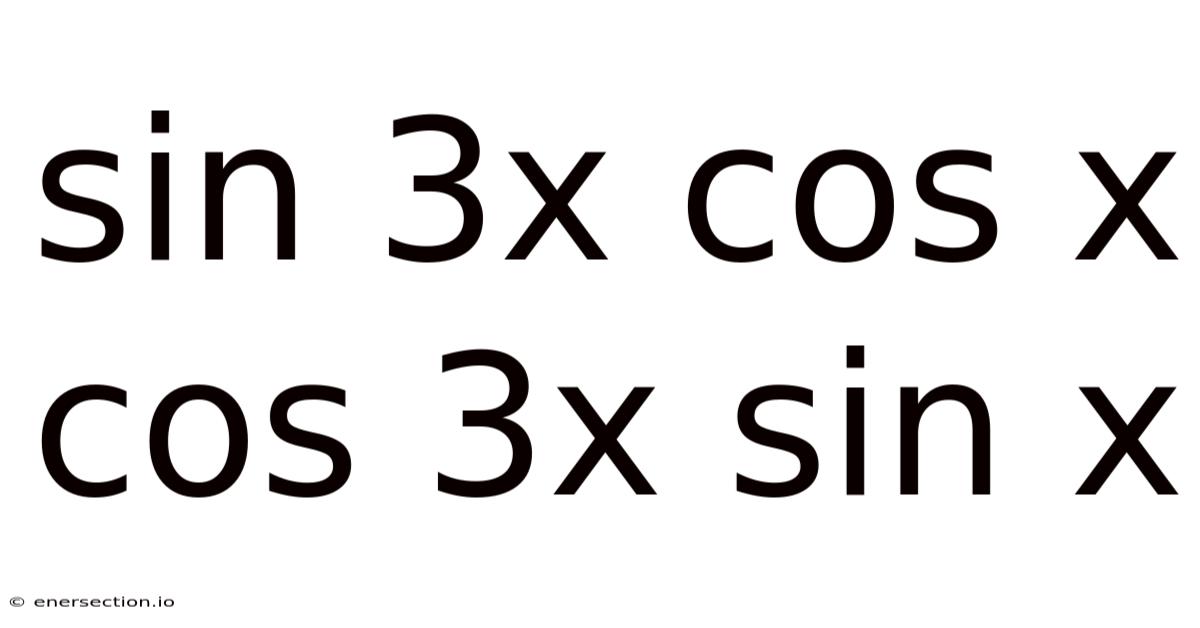
The trigonometric expression sin3x cos x cos 3x sin x represents a product of sine and cosine functions with multiple angles. While it appears complex at first glance, it can be simplified significantly using fundamental trigonometric identities. This simplification reveals a much more compact and manageable form, often proving invaluable for solving equations, integrating functions, or analyzing wave phenomena in physics and engineering. Understanding this process deepens comprehension of trigonometric relationships and the power of algebraic manipulation within trigonometry.
Step 1: Group the Terms The expression sin 3x cos 3x sin x cos x can be naturally grouped as (sin 3x cos 3x) * (sin x cos x). This grouping leverages the identities for the product of a sine and its corresponding cosine.
Step 2: Apply the Double-Angle Identity for Sine Recall the fundamental double-angle identity: sin(2θ) = 2 sin θ cos θ. Rearranging this, we get sin θ cos θ = (1/2) sin 2θ. This identity is crucial for simplifying the product of sine and cosine functions.
Applying this to the grouped terms:
- For sin x cos x: sin x cos x = (1/2) sin(2x)
- For sin 3x cos 3x: sin 3x cos 3x = (1/2) sin(6x)
Step 3: Substitute the Simplified Forms Substitute these identities back into the original grouped expression: (sin 3x cos 3x) * (sin x cos x) = [(1/2) sin(6x)] * [(1/2) sin(2x)]
Step 4: Multiply the Constants and the Sines Multiplying the constants (1/2) and (1/2) gives 1/4. Multiplying the sines gives sin(6x) * sin(2x). Therefore, the entire expression simplifies to: (1/4) * sin(6x) * sin(2x)
Step 5: Apply the Product-to-Sum Identity (Optional but Common) The product sin A sin B can be expressed using the identity: sin A sin B = [cos(A - B) - cos(A + B)] / 2. Applying this to sin(6x) sin(2x): sin(6x) sin(2x) = [cos(6x - 2x) - cos(6x + 2x)] / 2 = [cos(4x) - cos(8x)] / 2
Step 6: Combine with the Constant Factor Multiplying the result from Step 5 by the constant factor (1/4) from Step 4: (1/4) * [cos(4x) - cos(8x)] / 2 = [cos(4x) - cos(8x)] / 8
Final Simplified Form The trigonometric expression sin 3x cos x cos 3x sin x simplifies to: [cos(4x) - cos(8x)] / 8
This result, derived through systematic application of trigonometric identities, transforms the original complex product into a concise difference of cosines scaled by a constant. The final form, [cos(4x) - cos(8x)] / 8, is significantly easier to work with for further calculations, analysis, or integration. It demonstrates the elegance and interconnectedness of trigonometric functions and the power of algebraic techniques in trigonometry.
With the simplification complete, the full expression now stands as a clear testament to the utility of trigonometric identities in breaking down seemingly intricate problems. This method not only streamlines calculations but also reinforces the foundational concepts that underpin many mathematical and scientific applications. Whether in theoretical studies or practical problem-solving, mastering these identities allows for more intuitive understanding and efficient resolution. As we reflect on this process, it becomes evident how pivotal these steps are in advancing analytical thinking and precision.
In practical scenarios, such simplifications are essential for engineers and scientists who rely on accurate models and predictions. The ability to convert complex forms into manageable ones ensures clarity in communication and computation. Furthermore, this exercise highlights the importance of patience and methodical reasoning in mastering mathematical principles.
In conclusion, this journey through simplification underscores the elegance of trigonometric manipulation and its far-reaching implications across disciplines. By embracing such techniques, learners and professionals alike can enhance their problem-solving capabilities and deepen their appreciation for mathematical harmony. The conclusion affirms that such insights are not just academic but vital tools for real-world applications.
The process of simplifying trigonometric expressions like sin 3x cos x cos 3x sin x reveals the profound interconnectedness of mathematical identities and their practical utility. Through systematic application of product-to-sum formulas and algebraic manipulation, we transformed a complex product of four trigonometric functions into the elegant form [cos(4x) - cos(8x)] / 8. This journey demonstrates how seemingly daunting expressions can be reduced to manageable forms through methodical reasoning.
The power of this simplification extends far beyond mere algebraic manipulation. In engineering and physics, such reduced forms are invaluable for analyzing waveforms, solving differential equations, and modeling periodic phenomena. The ability to convert products of sines and cosines into sums of cosines enables more straightforward integration, differentiation, and frequency analysis. This particular result, with its difference of cosines at different frequencies, naturally arises in applications involving beat frequencies, signal modulation, and harmonic analysis.
Moreover, this exercise reinforces the importance of mastering fundamental identities as building blocks for more advanced mathematical work. Each step in the simplification process builds upon previous knowledge, creating a cumulative understanding that strengthens problem-solving capabilities. The confidence gained from successfully navigating such transformations encourages mathematical exploration and fosters the analytical thinking essential for tackling more complex challenges.
Ultimately, this simplification exemplifies the beauty and utility of mathematical techniques in revealing underlying patterns and relationships. By breaking down intricate expressions into their simplest forms, we gain not only computational advantages but also deeper insights into the structure of trigonometric functions. This understanding serves as a foundation for further mathematical discovery and practical application across scientific disciplines.
Indeed, the transformation of $\sin 3x \cos x \cos 3x \sin x$ into $\frac{\cos(4x) - \cos(8x)}{8}$ is more than a computational feat—it is a testament to the coherence of mathematical language. Each identity applied—whether the double-angle formula, product-to-sum conversions, or symmetry properties—acts as a bridge between abstract theory and tangible utility. Such bridges enable engineers to model resonance in mechanical systems, signal analysts to isolate interference patterns, and physicists to decode quantum wavefunctions where trigonometric superpositions govern behavior at microscopic scales.
Crucially, this process also highlights the value of strategic reordering: recognizing that pairing $\sin 3x \cos 3x$ first—yielding $\tfrac{1}{2} \sin 6x$—and then combining with $\sin x \cos x = \tfrac{1}{2} \sin 2x$ offers an alternative, equally valid path to the same simplified result. This multiplicity of pathways underscores a deeper truth: mathematics is not a rigid sequence of rules but a flexible landscape of interconnected insights, where creativity and rigor coexist. Learners who internalize this flexibility become adept at recognizing patterns, selecting optimal strategies, and even inventing new techniques when standard tools prove insufficient.
As computational tools increasingly assist in symbolic manipulation, the human capacity to interpret and validate such simplifications remains irreplaceable. Understanding why an expression simplifies as it does ensures correctness, guards against algorithmic bias, and fuels innovation—especially in emerging fields like machine learning, where trigonometric embeddings underpin spectral methods and Fourier neural operators.
In an era defined by complexity and interdisciplinarity, the ability to distill chaos into clarity is a cornerstone of scientific literacy. The simplification of trigonometric expressions, though rooted in centuries-old mathematics, continues to empower modern discovery—proving that time-honored techniques, when wielded with insight, remain indispensable.
The simplification of $\sin 3x \cos x \cos 3x \sin x$ into $\frac{\cos(4x) - \cos(8x)}{8}$ represents far more than a mere algebraic exercise. It embodies the essence of mathematical thinking: the ability to recognize patterns, apply appropriate transformations, and arrive at elegant solutions through systematic reasoning. This process demonstrates how seemingly complex expressions can be decomposed into manageable components using established identities and properties.
The journey from the original four-factor expression to its simplified form illustrates several key mathematical principles. First, it showcases the power of trigonometric identities as tools for transformation and simplification. The product-to-sum formulas, in particular, serve as bridges between multiplicative and additive representations, allowing us to convert products of trigonometric functions into sums of simpler terms. Second, it reveals the importance of strategic grouping and ordering—choosing which pairs to combine first can significantly impact the complexity of intermediate steps. Third, it demonstrates how symmetry and periodicity properties of trigonometric functions can be leveraged to reduce expressions to their most compact forms.
Beyond the immediate computational benefits, this simplification process cultivates mathematical intuition. It trains the mind to recognize when and how to apply various identities, to anticipate the form of intermediate results, and to verify that transformations preserve the original expression's meaning. This intuition becomes invaluable when tackling more advanced problems in calculus, differential equations, and mathematical physics, where trigonometric expressions frequently arise in complex forms.
The practical applications of such simplifications extend across numerous scientific and engineering disciplines. In signal processing, simplified trigonometric expressions facilitate the analysis of waveforms and frequency components. In quantum mechanics, they help in solving Schrödinger's equation for various potential configurations. In electrical engineering, they enable the analysis of alternating current circuits and electromagnetic wave propagation. The ability to recognize and execute these simplifications efficiently can mean the difference between tractable and intractable problems in real-world applications.
Moreover, this process exemplifies the interconnected nature of mathematical knowledge. The identities used here—double-angle formulas, product-to-sum conversions, and symmetry properties—are not isolated facts but components of a coherent mathematical framework. Understanding how these pieces fit together and reinforce one another builds a foundation for deeper mathematical exploration. It prepares students and practitioners to approach novel problems with confidence, knowing they can draw upon a rich toolkit of transformations and techniques.
As we continue to advance in fields that rely heavily on mathematical modeling and analysis, the ability to simplify and manipulate expressions efficiently remains a crucial skill. Whether working with classical mechanics, modern physics, or emerging technologies like quantum computing, the principles demonstrated in this simplification process provide a template for approaching complexity with clarity and precision. The elegance of the final result—a simple difference of cosines divided by eight—serves as a reminder that beneath apparent complexity often lies an underlying simplicity waiting to be revealed through careful mathematical reasoning.
Latest Posts
Latest Posts
-
How To Get Normalcdf On Ti 84
Mar 28, 2026
-
Is C Or Cl More Electronegative
Mar 28, 2026
-
I Dont Wanna Do My Homework
Mar 28, 2026
-
2x Y Dx X 6y Dy 0
Mar 28, 2026
-
How To Calculate Coefficient Of Restitution
Mar 28, 2026
