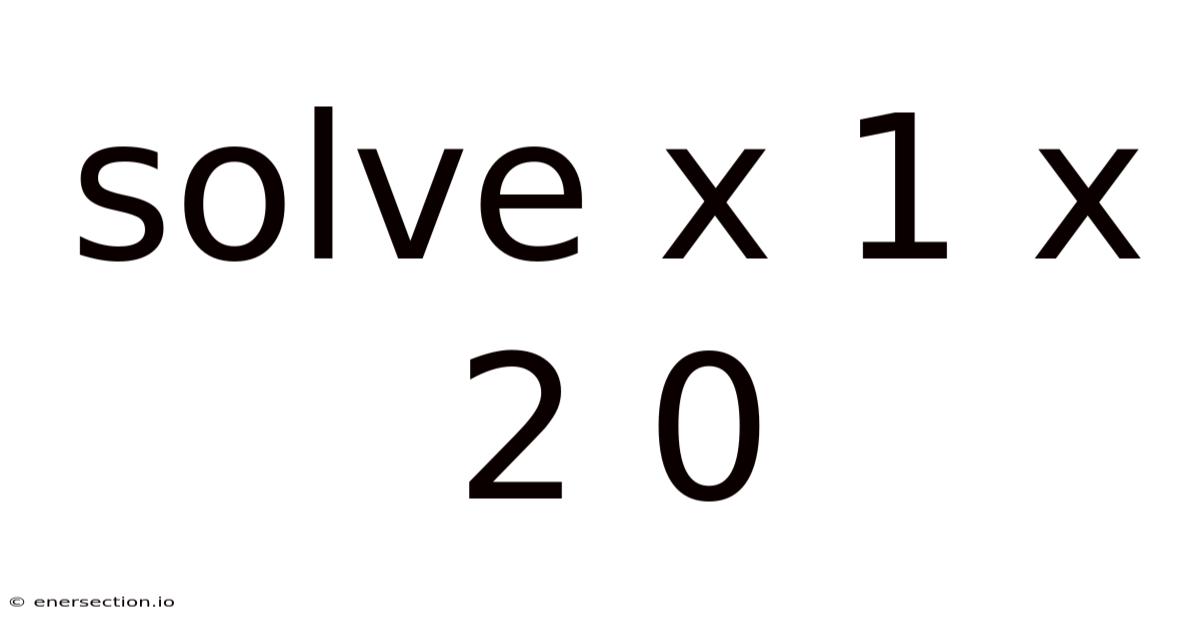
Solving the Equation x₁ × x₂ = 0
When you encounter an algebraic expression that looks like x₁ × x₂ = 0, you’re dealing with a product set equal to zero. Which means understanding how to solve them not only sharpens your algebraic skills but also builds a foundation for more advanced topics like polynomial factorization and differential equations. Such equations are common in introductory algebra, calculus, and even higher‑level mathematics. In this article we’ll explore the theory, step‑by‑step methods, practical applications, and common pitfalls associated with solving equations of the form x₁ × x₂ = 0.
Introduction
The Zero‑Product Property is a cornerstone of algebra. It states that if the product of two numbers (or expressions) equals zero, then at least one of the factors must be zero. Symbolically:
If (a \times b = 0) then (a = 0) or (b = 0).
This seemingly simple rule unlocks a powerful technique for solving quadratic equations, higher‑degree polynomials, and systems of equations. In our case, we have two variables, (x_1) and (x_2), and the equation:
[ x_1 \times x_2 = 0 ]
The goal is to find all possible ordered pairs ((x_1, x_2)) that satisfy this condition.
Step‑by‑Step Solution
-
Identify the factors
The expression is already factored into two components: (x_1) and (x_2). -
Apply the Zero‑Product Property
Set each factor equal to zero separately:[ \begin{cases} x_1 = 0 \ x_2 = 0 \end{cases} ]
-
Solve each equation
Each equation is trivial: the solution is the value that makes the factor zero.- For (x_1 = 0): the solution is (x_1 = 0), while (x_2) can be any real number.
- For (x_2 = 0): the solution is (x_2 = 0), while (x_1) can be any real number.
-
Combine the results
The complete set of solutions is:[ {(x_1, x_2) \mid x_1 = 0 \text{ or } x_2 = 0} ]
In set‑builder notation:
[ {(0, y) \mid y \in \mathbb{R}} \cup {(x, 0) \mid x \in \mathbb{R}} ]
Visually, this corresponds to the two coordinate axes on the Cartesian plane Worth keeping that in mind..
Visual Interpretation
Plotting the solution set on a Cartesian coordinate system gives you two perpendicular lines:
- The x‑axis: all points where (x_2 = 0).
- The y‑axis: all points where (x_1 = 0).
The intersection point ((0,0)) satisfies both conditions simultaneously. Every other point on either axis satisfies the equation because the product of one zero factor and any real number is zero.
Scientific Explanation
The Zero‑Product Property is a direct consequence of the distributive and identity properties of multiplication in the real numbers. Recall:
- Distributive Law: (a(b + c) = ab + ac).
- Multiplicative Identity: (a \times 1 = a).
- Zero Element: (a \times 0 = 0) for any real number (a).
If (a \times b = 0), then at least one of (a) or (b) must be the zero element of the number system, because only multiplication by zero yields zero. This principle holds in many algebraic structures (rings, fields) where zero is defined as the additive identity.
Common Applications
| Context | How the Zero‑Product Property Helps |
|---|---|
| Quadratic Equations | Factor (ax^2 + bx + c) into ((x - r_1)(x - r_2) = 0). |
| Systems of Equations | When a system includes a product set to zero, split into separate equations to reduce complexity. Here's the thing — |
| Optimization | Setting partial derivatives equal to zero often yields products that are zero; solve for critical points. |
| Polynomial Roots | Factor a polynomial into linear factors and apply the property repeatedly. Plus, then (x = r_1) or (x = r_2). |
| Physics | Equations like (mv = 0) (momentum) imply either mass or velocity is zero, guiding problem‑solving. |
Frequently Asked Questions (FAQ)
1. Can both factors be non‑zero and still satisfy the equation?
No. In the real number system, the only way a product can be zero is if at least one factor is zero. If both are non‑zero, their product is non‑zero.
2. What if the equation involves more than two factors, e.g., (x_1 x_2 x_3 = 0)?
Apply the Zero‑Product Property iteratively. The solution set is the union of all cases where at least one factor equals zero Most people skip this — try not to. That's the whole idea..
3. Does this property hold in complex numbers?
Yes. The complex numbers form a field, and the zero‑product property remains valid Easy to understand, harder to ignore..
4. What if the equation is (x_1^2 x_2 = 0)?
Set each factor equal to zero: (x_1^2 = 0) gives (x_1 = 0); (x_2 = 0) remains as is. The solution set is the same as before.
5. Can the property be used in inequalities?
Not directly. For inequalities, you must consider sign changes and zero intervals separately.
Practical Tips for Students
- Always check for extraneous solutions when the equation has been manipulated (e.g., multiplying by a variable that might be zero).
- Use factoring early. A complicated-looking equation often hides simple factors.
- Graph the solution set. Visualizing the axes helps reinforce the concept.
- Practice with higher‑degree polynomials. The zero‑product property is a stepping stone to solving cubic and quartic equations.
Conclusion
Solving the equation x₁ × x₂ = 0 is a gateway to mastering algebraic problem‑solving. By leveraging the Zero‑Product Property, you can decompose complex expressions into manageable pieces, uncover all possible solutions, and develop a deeper appreciation for the structure of the real number system. Whether you’re tackling quadratic equations, analyzing physical phenomena, or preparing for advanced mathematics, this simple yet powerful technique remains indispensable.
Extending the Concept to Multiple Variables When the product involves three or more factors, the same principle applies: the entire expression equals zero if any factor is zero. Here's one way to look at it: the equation
[ x_1 x_2 x_3 = 0 ]
yields the solution set
[ {x_1 = 0} \cup {x_2 = 0} \cup {x_3 = 0}. ]
This union‑type reasoning can be generalized to any finite product, and it underlies many algorithmic strategies in computer algebra systems, where factorization is performed recursively until each irreducible component is identified Not complicated — just consistent..
Numerical Methods When Factoring Is Impractical
In many real‑world scenarios the factors are not readily apparent. Numerical root‑finding techniques — such as Newton‑Raphson, the bisection method, or quasi‑Newton schemes — make it possible to approximate zeros of a function even when an explicit factorization is unavailable. By treating each factor as a separate function, one can isolate intervals where the sign changes, then refine those intervals until the desired precision is achieved.
Applications in Linear Algebra
The zero‑product property also appears in the study of matrices. If a matrix product (AB = 0) (the zero matrix) holds, it does not necessarily imply that either (A) or (B) is the zero matrix; however, it does guarantee that the column space of (B) lies within the nullspace of (A). Understanding this relationship is crucial for analyzing systems of linear equations, controllability in control theory, and stability in dynamical systems.
Computational Tools and Software
Modern computer algebra systems (CAS) — such as Mathematica, Maple, or SymPy — implement sophisticated factorization algorithms that automatically apply the zero‑product property. Users can issue a single command like solve(x1*x2, x1) and receive the full solution set instantly. For large‑scale problems, these tools often combine symbolic factorization with numeric approximation to handle polynomials of high degree or systems with many variables It's one of those things that adds up..
Visualizing Solutions in Higher Dimensions
When dealing with equations in three or more variables, the solution set becomes a collection of hyperplanes. Here's a good example: the equation
[ (x - 1)(y + 2)(z)^2 = 0 ]
describes the union of three distinct hyperplanes: (x = 1), (y = -2), and (z = 0). Plotting these surfaces in a 3‑D coordinate system helps students develop an intuitive grasp of how algebraic conditions translate into geometric objects.
A Forward Look: From Products to Sums
While the zero‑product property focuses on multiplication, many advanced topics pivot to additive structures. Practically speaking, concepts such as resultants, discriminants, and Vieta’s formulas connect the roots of a polynomial to its coefficients through sums and products. Mastery of the product‑based approach provides a solid foundation for exploring these richer algebraic relationships Simple as that..
Final Perspective
Understanding how to resolve an equation like (x_1 \times x_2 = 0) is more than a mechanical exercise; it cultivates a mindset that sees complexity as a collection of simpler, interpretable pieces. Which means by repeatedly applying the zero‑product property — whether to a quadratic trinomial, a multivariable polynomial, or a matrix equation — students build a versatile toolkit that bridges symbolic manipulation, geometric intuition, and practical problem‑solving. This foundational insight not only streamlines current coursework but also equips learners for the sophisticated algebraic frameworks they will encounter in graduate studies, scientific computing, and beyond Most people skip this — try not to..
