V 2 V0 2 2a X X0

enersection
Mar 15, 2026 · 5 min read
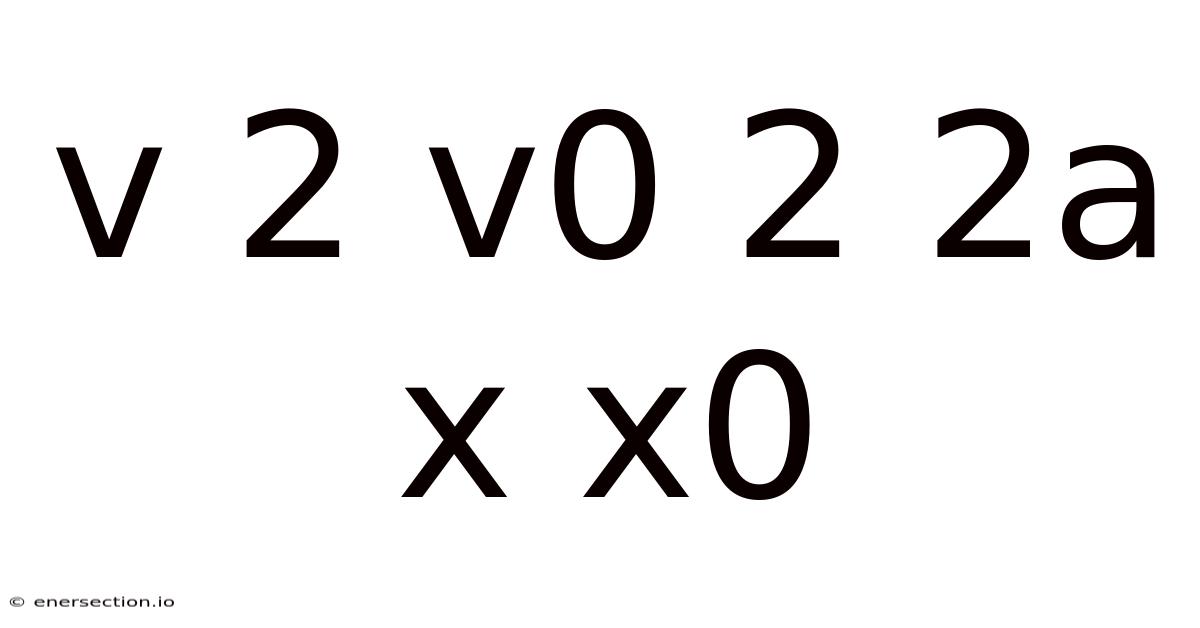
Table of Contents
V² = v₀² + 2a(x - x₀): Understanding the Kinematic Equation
This article explores the kinematic equation V² = v₀² + 2a(x - x₀), a fundamental formula in physics that relates final velocity, initial velocity, acceleration, and displacement. This equation is essential for solving motion problems where time is not explicitly involved.
Introduction to the Equation
The equation V² = v₀² + 2a(x - x₀) is one of the four standard kinematic equations used to describe motion under constant acceleration. It connects five variables:
- V = final velocity
- v₀ = initial velocity
- a = acceleration
- x = final position
- x₀ = initial position
This equation is particularly useful when you need to find the final velocity of an object without knowing the time it took to travel between positions. It's commonly applied in scenarios like free fall, projectile motion, and vehicle acceleration problems.
Understanding Each Component
Final Velocity (V): The speed and direction of an object at the end of its motion. This is what we often want to calculate using this equation.
Initial Velocity (v₀): The starting speed and direction of the object. This could be zero if the object starts from rest, or it could be any value depending on the scenario.
Acceleration (a): The rate of change of velocity. This can be positive (speeding up), negative (slowing down), or zero (constant velocity). For objects in free fall near Earth's surface, a = 9.8 m/s² downward.
Displacement (x - x₀): The change in position from the starting point to the ending point. This is a vector quantity, meaning it has both magnitude and direction.
When to Use This Equation
The V² = v₀² + 2a(x - x₀) equation is most appropriate when:
- Time is not given or not needed in the problem
- You know three of the five variables and need to find the fourth
- The acceleration is constant throughout the motion
- You're dealing with straight-line motion
Step-by-Step Problem Solving
To effectively use this equation, follow these steps:
- Identify known variables: Determine which three of the five variables you have information about
- Assign correct signs: Be careful with positive and negative signs, especially for acceleration and displacement
- Substitute values: Plug the known values into the equation
- Solve algebraically: Rearrange the equation if necessary to isolate the unknown variable
- Check units: Ensure all measurements are in consistent units (typically meters and seconds in physics)
Practical Example
Consider a car accelerating from rest at 3 m/s² over a distance of 50 meters. What is its final velocity?
Given:
- v₀ = 0 m/s (starts from rest)
- a = 3 m/s²
- x - x₀ = 50 m
Substituting into the equation: V² = 0² + 2(3)(50) V² = 300 V = √300 ≈ 17.3 m/s
The car reaches a final velocity of approximately 17.3 m/s.
Common Applications
This equation has numerous real-world applications:
Automotive Engineering: Calculating stopping distances for vehicles, determining acceleration performance, and designing safety systems.
Sports Science: Analyzing the motion of athletes, calculating takeoff velocities in jumping events, and optimizing performance in various sports.
Astronomy: Determining the velocity of celestial objects, calculating escape velocities, and analyzing orbital mechanics.
Mechanical Engineering: Designing machinery with moving parts, calculating the motion of components in mechanical systems, and ensuring proper operation of mechanical devices.
Relationship to Other Kinematic Equations
The V² = v₀² + 2a(x - x₀) equation is part of a family of four kinematic equations. The others are:
- v = v₀ + at (velocity-time relationship)
- x = x₀ + v₀t + ½at² (position-time relationship)
- x = x₀ + ½(v₀ + v)t (average velocity relationship)
Each equation is useful in different scenarios, and they can be used together to solve complex motion problems.
Scientific Explanation
The derivation of this equation comes from combining the definitions of velocity and acceleration. Starting with the basic definitions:
- Acceleration: a = (v - v₀)/t
- Average velocity: (v + v₀)/2 = (x - x₀)/t
By eliminating time from these equations and performing algebraic manipulation, we arrive at the V² = v₀² + 2a(x - x₀) relationship. This demonstrates the interconnected nature of motion variables in physics.
Limitations and Considerations
While this equation is powerful, it has some limitations:
- It only applies to motion with constant acceleration
- It assumes motion in a straight line (one dimension)
- It doesn't account for air resistance or other external forces
- It requires accurate measurement of initial conditions
Frequently Asked Questions
Q: Can this equation be used for free-falling objects? A: Yes, with a = -9.8 m/s² (downward) for objects near Earth's surface.
Q: What if I need to find acceleration but don't know displacement? A: You would need to use a different kinematic equation that relates the variables you do know.
Q: Does this work for objects moving in a circle? A: No, this equation is for linear motion. Circular motion requires different equations involving angular velocity and centripetal acceleration.
Q: How accurate is this equation in real-world applications? A: It's very accurate for idealized situations with constant acceleration, but real-world factors like air resistance may cause slight deviations.
Conclusion
The kinematic equation V² = v₀² + 2a(x - x₀) is an indispensable tool in physics for analyzing motion when time is not a factor. By understanding its components, applications, and limitations, students and professionals can solve a wide range of motion problems with confidence. Whether you're calculating the stopping distance of a vehicle, analyzing an athlete's performance, or designing mechanical systems, this equation provides a reliable framework for understanding how objects move through space under constant acceleration.
Latest Posts
Latest Posts
-
What Is The Hardest Math Subject
Mar 15, 2026
-
Best Compact All In One Printer
Mar 15, 2026
-
How To Do Absolute Value On A Ti 84
Mar 15, 2026
-
What Causes A Battery To Drain
Mar 15, 2026
-
How Long Should I Leave Phone In Rice
Mar 15, 2026
Related Post
Thank you for visiting our website which covers about V 2 V0 2 2a X X0 . We hope the information provided has been useful to you. Feel free to contact us if you have any questions or need further assistance. See you next time and don't miss to bookmark.
