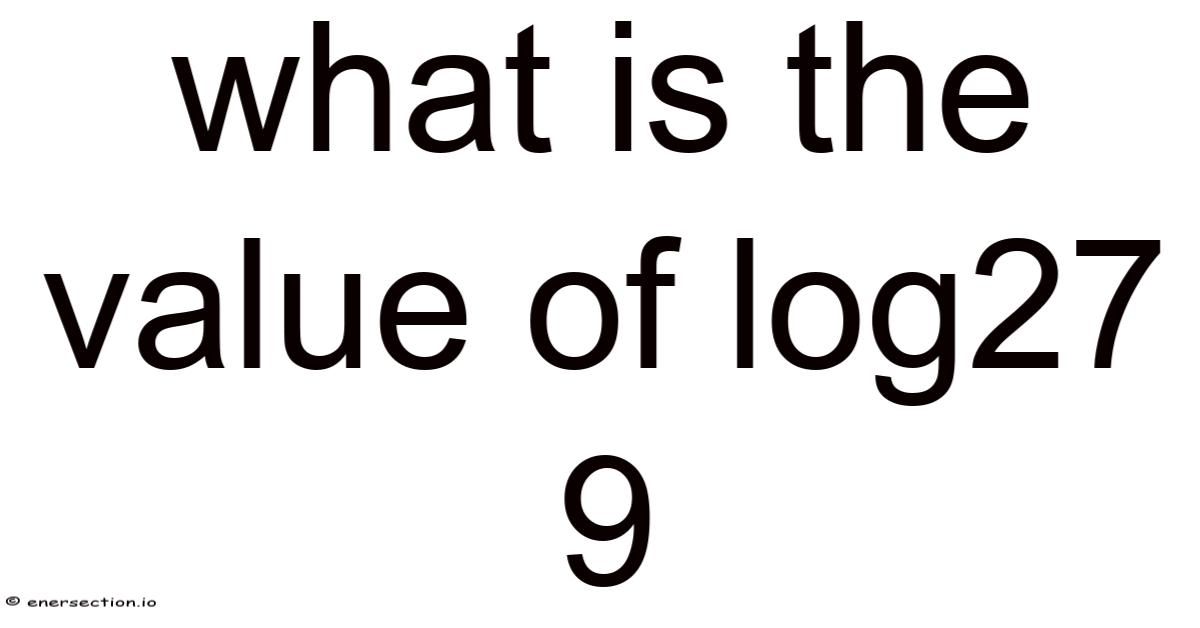
What Is the Value of Log₂₇ 9?
Logarithms are a fundamental concept in mathematics that help us understand exponential relationships in a more manageable way. One such logarithmic expression that often puzzles students is log₂₇ 9. This article will explore the value of this logarithm, explain the underlying principles, and provide a clear step-by-step solution to help you grasp the concept thoroughly The details matter here..
Understanding Logarithms
Before diving into the calculation, it’s essential to recall what logarithms represent. Also, a logarithm answers the question: *To what power must a base be raised to obtain a specific number? * Take this: log₂₇ 9 asks, "To what power must 27 be raised to get 9?
Mathematically, if log_b a = x, then b^x = a. In this case, we’re looking for the exponent that makes 27 raised to it equal to 9. Let’s break this down Worth keeping that in mind..
Step-by-Step Solution to Find Log₂₇ 9
Step 1: Express the Numbers in Terms of a Common Base
Notice that both 27 and 9 are powers of 3:
- 27 = 3³
- 9 = 3²
This observation is crucial because it allows us to simplify the logarithm using the power rule of exponents Small thing, real impact. Which is the point..
Step 2: Rewrite the Logarithm Using the Common Base
Using the expressions above, we can rewrite log₂₇ 9 as: $ \log_{3^3} 3^2 $
Step 3: Apply the Logarithm Power Rule
The logarithm power rule states that log_{b^c} (a^d) = (d/c) log_b a. Applying this here: $ \log_{3^3} 3^2 = \frac{2}{3} \log_3 3 $
Step 4: Simplify the Expression
Since log_3 3 = 1 (because 3¹ = 3), the equation becomes: $ \frac{2}{3} \times 1 = \frac{2}{3} $
Thus, the value of log₂₇ 9 is 2/3 Practical, not theoretical..
Scientific Explanation: Why Does This Work?
Logarithms are deeply connected to exponents and the properties of numbers. By expressing 27 and 9 as powers of 3, we use the change of base and power rules to simplify the calculation. Here’s why this method is effective:
- Change of Base: Converting both numbers to the same base (in this case, base 3) allows us to manipulate the logarithm more easily. This is a common strategy when dealing with logarithms of composite numbers.
- Power Rule: The rule log_{b^c} (a^d) = (d/c) log_b a is derived from the fundamental properties of exponents. It essentially tells us that raising a base to a power can be factored out of the logarithm.
This approach not only simplifies the problem but also reinforces the relationship between exponents and logarithms. It’s a testament to how mathematical principles interconnect to solve seemingly complex problems.
Verifying the Answer
To ensure our solution is correct, we can convert the logarithmic result back into exponential form. If log₂₇ 9 = 2/3, then: $ 27^{2/3} = 9 $
Let’s verify this:
- 27^(1/3) = 3 (since 3³ = 27)
- So, 27^(2/3) = (27^(1/3))² = 3² = 9
This confirms that our answer is accurate.
Real-World Applications of Logarithms
While log₂₇ 9 might seem abstract, logarithms are widely used in various fields:
- Computer Science: Binary logarithms (base 2) are essential in algorithms and data structures.
- Engineering: Logarithmic scales measure sound intensity (decibels) and earthquake magnitude (Richter scale).
- Finance: Compound interest calculations often involve logarithms to determine growth rates over time.
Understanding logarithms helps in solving problems across these domains, making them a vital tool in both academic and practical contexts.
Frequently Asked Questions (FAQ)
Q1: Why is log₂₇ 9 equal to 2/3?
A: Because 27^(2/3) equals 9 when simplified. This is derived by expressing both numbers as powers of 3 and applying logarithmic rules Easy to understand, harder to ignore..
Q2: Can I use a calculator to find log₂₇ 9?
A: Yes, using the change of base formula: log₂₇ 9 = (ln 9)/(ln 27) or (log 9)/(log 27). On the flip side, recognizing the common base (3) makes the calculation faster and more intuitive.
Q3: What if I don’t notice that 27 and 9 are powers of 3?
A: You can still solve it using the change of base formula or by trial and error. That said, identifying common bases is a powerful shortcut in logarithmic problems.
Q4: Is there a decimal equivalent for 2/3?
A: Yes, 2/3 is approximately 0.6667. That said, the exact fractional form is preferred in mathematical contexts for precision Easy to understand, harder to ignore..
Conclusion
The value
The value of log₂₇ 9 is indeed 2/3, as demonstrated through the application of logarithmic identities and verified by converting back to exponential form. This problem exemplifies how recognizing common bases and applying fundamental rules can simplify complex calculations. Beyond theoretical mathematics, logarithms play a important role in diverse fields such as computer science, engineering, and finance, underscoring their practical utility. By mastering these concepts, students and professionals alike can approach logarithmic problems with confidence and appreciate the interconnectedness of mathematical principles in both academic and real-world scenarios Less friction, more output..
The value of log₂₇ 9 is indeed (\frac{2}{3}), as demonstrated through the application of logarithmic identities and verified by converting back to exponential form. This problem exemplifies how recognizing common bases and applying fundamental rules can simplify seemingly complex calculations Still holds up..
Beyond pure mathematics, logarithms permeate a wide array of disciplines—computer science (algorithm analysis, data compression), engineering (acoustics, seismology), biology (population dynamics), and finance (compound interest, risk assessment). Mastery of logarithmic thinking not only equips you to solve textbook exercises but also to model real‑world phenomena that evolve multiplicatively.
Key Takeaways
- Identify a common base whenever possible; it often turns a cumbersome logarithm into a simple fraction.
- Use the change‑of‑base formula ((\log_a b = \frac{\ln b}{\ln a}) or (\frac{\log b}{\log a})) as a reliable fallback when a common base isn’t obvious.
- Verify by exponentiation: if (\log_a b = c), then (a^c = b). This step catches algebraic slip‑ups before they propagate.
- Interpret the result: a logarithm’s value tells you “how many times you must raise the base to reach the argument,” a concept that underlies growth rates, scaling laws, and information theory.
Final Thought
Understanding the mechanics behind (\log_{27}9 = \frac{2}{3}) does more than give you a correct answer; it reinforces a problem‑solving mindset that looks for structure, exploits patterns, and validates results. Whether you’re tackling a high‑school algebra test or designing a signal‑processing algorithm, that same mindset will serve you well That's the whole idea..
So the next time you encounter a logarithm that looks daunting, remember: look for a shared base, apply the exponent rules, and double‑check by raising the base to the computed power. With these tools, any logarithmic challenge becomes manageable.
Continuing smoothly from the established foundation, the practical reach of logarithms extends even further into specialized domains where multiplicative relationships dominate. Practically speaking, Epidemiology employs logarithmic models to track the spread of diseases, where exponential growth patterns are transformed into linear trends for easier analysis and intervention planning. Consider this: in chemistry, the pH scale (pH = -log[H⁺]) quantifies acidity using a logarithmic scale, as each unit represents a tenfold change in hydrogen ion concentration. Information theory, pioneered by Claude Shannon, relies on logarithms (specifically base-2) to measure information content in bits, defining the fundamental unit of digital data Still holds up..
For tackling more complex logarithmic equations, logarithmic identities become indispensable tools beyond the change-of-base formula. Think about it: the power rule ((\log_a (b^c) = c \log_a b)) simplifies expressions like (\log_{10} (1000^2)) to (2 \log_{10} 1000 = 2 \times 3 = 6). The product rule ((\log_a (bc) = \log_a b + \log_a c)) and quotient rule ((\log_a (b/c) = \log_a b - \log_a c)) allow decomposition of layered arguments. Here's a good example: solving (\log_2 (x \cdot 8) = 5) becomes straightforward: (\log_2 x + \log_2 8 = 5 \implies \log_2 x + 3 = 5 \implies \log_2 x = 2 \implies x = 4).
Short version: it depends. Long version — keep reading.
Graphically, logarithmic functions reveal unique properties. The graph of (y = \log_a x) (for (a > 1)) passes through ((1, 0)), has a vertical asymptote at (x = 0), and exhibits slow growth, contrasting sharply with exponential functions. This characteristic makes logarithmic scales ideal for visualizing data spanning several orders of magnitude, such as Richter scale earthquake magnitudes or stellar brightness (apparent magnitude).
Advanced Considerations
When dealing with logarithmic equations involving variables in exponents or arguments, combining algebraic manipulation with logarithmic rules is key. To give you an idea, solving (2^{x+1} = 5^x) requires taking the logarithm of both sides: ((x+1)\log 2 = x \log 5). Rearranging yields (x \log 5 - x \log 2 = \log 2 \implies x(\log 5 - \log 2) = \log 2 \implies x = \frac{\log 2}{\log 5 - \log 2}). This highlights how logarithms bridge exponential equations with linear algebra.
Conclusion
The journey from solving (\log_{27} 9 = \frac{2}{3}) to exploring logarithmic identities, graphical behavior, and diverse real-world applications underscores a profound truth: logarithms are not merely abstract symbols but fundamental translators of multiplicative worlds into linear frameworks. Their ability to compress vast scales, model growth and decay, and decode complex multiplicative relationships makes them indispensable across science, engineering, finance, and beyond. Mastery of logarithmic thinking cultivates a powerful analytical lens, enabling us to dissect exponential phenomena, manage exponential data spaces, and solve problems that would otherwise remain intractable. Whether calibrating a pH meter, optimizing an algorithm, or understanding population dynamics, the logarithmic perspective remains an essential tool for interpreting and shaping our exponentially evolving world.
