What The Meaning Of This Symbol :

enersection
Mar 15, 2026 · 6 min read
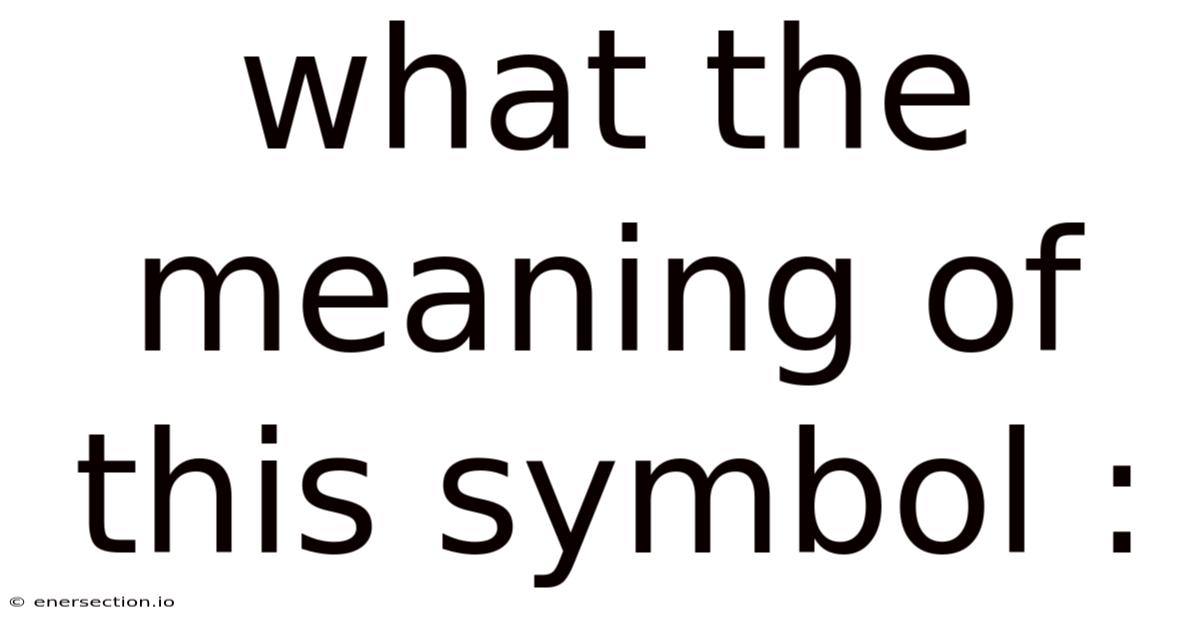
Table of Contents
The symbol : has multiple meanings depending on the context in which it is used. This small yet powerful punctuation mark plays a crucial role in written communication, serving various functions across different fields including grammar, mathematics, computing, and even in everyday notation.
In grammar and writing, the colon is primarily used to introduce lists, explanations, or quotations. For example, when you write "I need to buy three things: milk, bread, and eggs," the colon signals that what follows is a list of items. It can also introduce an explanation or elaboration, as in "He had one goal: to win the championship." In these cases, the colon creates a pause that prepares the reader for important information that follows.
In mathematics, the colon takes on several meanings. It often represents ratios, as in "3:2" which means three to two. In set theory and logic, it can mean "such that," as in the notation {x : x > 0} which reads as "the set of all x such that x is greater than zero." In some mathematical contexts, especially in older texts, it can also represent division or be used as a separator between hours and minutes when writing time.
In computing and programming, the colon serves various specialized functions. In many programming languages, it's used to separate parts of a statement or to indicate the beginning of a block of code. For instance, in Python, a colon at the end of a line like "if x > 0:" indicates that the following indented lines are part of that conditional statement. In URLs and file paths, colons separate different parts of the address, such as the protocol (http:) or the drive letter in Windows paths (C:).
The symbol also appears in time notation, where it separates hours, minutes, and seconds. When you see "14:30," the colon clearly divides the hours from the minutes. This usage extends to other measurements where subdivisions need to be indicated clearly.
In linguistics and phonetics, the colon can represent a long vowel sound in the International Phonetic Alphabet (IPA). For example, the symbol /a:/ represents a long "a" sound, as opposed to the short /a/ sound. This usage helps linguists and language learners accurately represent pronunciation.
In literature and creative writing, authors sometimes use colons for dramatic effect or to create specific rhythms in their prose. The pause created by a colon can build anticipation or emphasize a particular point. Some writers use it to create parallel structures or to highlight contrasts between ideas.
In formal writing and documentation, colons often introduce salutations in business letters ("Dear Sir:") or separate titles from subtitles in books and articles ("The Great Gatsby: A Novel of the Jazz Age"). They're also used in bibliographies and reference lists to separate different elements of citations.
The colon has historical significance as well. It evolved from medieval punctuation marks and was standardized in its current form during the printing revolution. Its design, with two equally sized dots, was chosen for its visual balance and clarity.
In digital communication, especially in text messages and social media, the colon has taken on new life as part of emoticons and emoji combinations. While not the main component, it often appears in expressions like ":)" or ":D" to convey emotions and tone.
Understanding the proper use of the colon is essential for clear and effective communication. Its versatility makes it one of the most useful punctuation marks, capable of organizing information, creating emphasis, and facilitating complex expressions in various contexts. Whether you're writing an academic paper, coding a program, or simply noting the time, the humble colon plays a vital role in conveying meaning accurately and efficiently.
The colon's adaptability across different fields demonstrates its importance in human communication. From structuring complex sentences to organizing data in programming, from indicating time to representing phonetic sounds, this simple punctuation mark serves countless purposes. Its presence in both formal and informal contexts, from academic papers to text messages, underscores its universal utility.
As language and technology continue to evolve, the colon remains a steadfast tool for clarity and precision. Whether you're a writer crafting a compelling argument, a programmer debugging code, or simply jotting down a time for a meeting, the colon stands ready to help you express yourself more effectively. Its enduring relevance is a testament to the power of well-designed punctuation in facilitating human understanding and expression.
Ultimately, the colon isn't just a punctuation mark; it's a subtle yet powerful instrument of communication. It’s a quiet guide, ensuring clarity and precision in a world often saturated with information. By understanding its nuances and applying it thoughtfully, we can elevate our writing, enhance our understanding, and foster more meaningful connections. The colon’s continued relevance speaks volumes about the enduring value of careful consideration in conveying ideas – a value that remains paramount in all forms of expression, both written and digital.
Beyond the realms already explored, the colon finds a quiet but indispensable role in legal drafting. Statutes and contracts frequently employ it to introduce definitions, conditions, or lists of obligations, thereby reducing ambiguity. For instance, a clause might read: “The Party shall deliver the goods: (a) on the agreed date; (b) in the specified quantity; and (c) at the designated location.” Here the colon signals that what follows elaborates on the preceding statement, guiding the reader through layered requirements without the need for repetitive phrasing.
In the world of poetry, the colon can act as a pivot that invites the reader to pause and consider the imagery that follows. Modern poets sometimes use it to juxtapose a concrete observation with an abstract reflection, creating a tension that enriches the verse. A line such as “She watched the rain: each drop a memory falling sideways” leverages the colon to bridge sensation and sentiment, allowing the poem to breathe between two complementary ideas.
Mathematics and science also rely on the colon to express ratios and proportions, a notation that predates its linguistic uses. The expression “3:1” succinctly conveys that for every three units of one quantity there is one unit of another, a relationship that would be cumbersome to articulate in words alone. Similarly, in scientific notation, a colon may separate variables in a formula to highlight the operational steps, as seen in certain algorithmic descriptions where “input:process:output” clarifies the flow of data.
Even in everyday scheduling, the colon’s utility shines. Digital calendars and reminder apps often display events as “14:30 – Team briefing,” where the colon separates hour from minute, enabling quick visual parsing across time zones and platforms. This consistency reinforces punctuation’s role as a universal shorthand that transcends language barriers.
When we step back and view the colon across these varied landscapes—legal texts, poetic verses, mathematical equations, and digital interfaces—it becomes clear that its strength lies in its ability to create a deliberate pause that signals elaboration, contrast, or relationship. By marking a transition, the colon helps the audience navigate complex information without losing the thread of meaning.
In conclusion, the modest colon, comprised merely of two dots, continues to prove its worth as a versatile conduit for clarity. Whether it is introducing a list, sharpening a legal definition, deepening a poetic image, denoting a ratio, or separating hours from minutes, it serves as a silent guide that structures our thoughts and enhances comprehension. Embracing its nuanced applications empowers writers, professionals, and everyday communicators to convey ideas with precision and elegance, affirming that even the smallest symbols can wield considerable influence in the tapestry of human expression.
Latest Posts
Latest Posts
-
Do You Need Common Denominators When Multiplying Fractions
Mar 15, 2026
-
How To Find Sine Without A Calculator
Mar 15, 2026
-
Is Ionic Bond Stronger Than Covalent
Mar 15, 2026
-
Why Are Flies Attracted To Feces
Mar 15, 2026
-
Is Density An Intensive Or Extensive Property
Mar 15, 2026
Related Post
Thank you for visiting our website which covers about What The Meaning Of This Symbol : . We hope the information provided has been useful to you. Feel free to contact us if you have any questions or need further assistance. See you next time and don't miss to bookmark.
