X X0 V0t 1 2at 2

enersection
Mar 12, 2026 · 4 min read
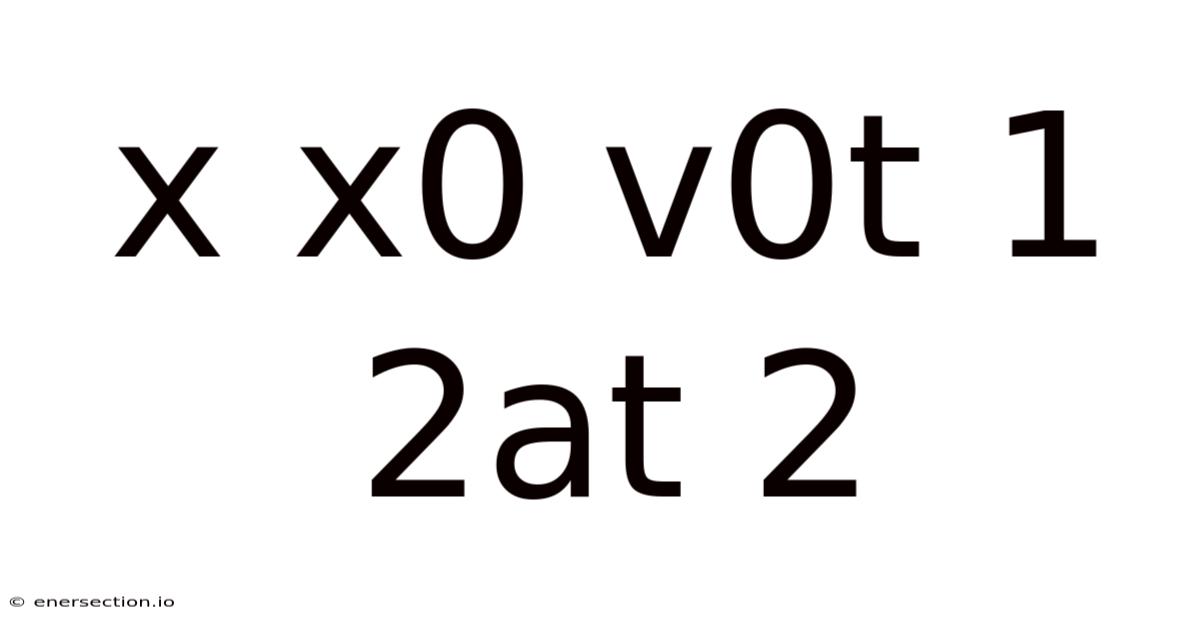
Table of Contents
Understanding the Equation of Motion: x = x₀ + v₀t + ½at²
The equation x = x₀ + v₀t + ½at² is one of the most powerful and frequently used formulas in classical mechanics. It describes the relationship between an object's displacement, its initial conditions, and its constant acceleration over time. Whether you're calculating the trajectory of a thrown baseball, the stopping distance of a car, or the path of a falling object, this kinematic equation provides the mathematical backbone. Mastering it unlocks a deeper understanding of motion itself, transforming abstract concepts into predictable, solvable realities. This article will break down every component of this fundamental equation, explore its derivation, demonstrate its wide-ranging applications, and provide the clarity needed to use it confidently in both academic and real-world scenarios.
Breaking Down the Components: What Each Symbol Means
Before applying the equation, a precise understanding of each variable is essential. The formula connects five key quantities, all describing motion along a straight line (one dimension).
- x: This represents the final position or displacement of the object at time t. It answers the question: "Where is the object after a certain time?"
- x₀ (x-naught): This is the initial position. It's the starting point of the object at time t = 0. Often, problems set x₀ = 0 for simplicity, meaning the origin of the coordinate system is at the start point.
- v₀ (v-naught): The initial velocity. This is the speed and direction of the object at the exact moment we begin timing (t = 0). It's a vector quantity, so its sign (positive or negative) indicates direction relative to the chosen coordinate system.
- t: The time elapsed from the initial moment. It is always a positive scalar quantity.
- a: The constant acceleration. This is the rate at which the object's velocity changes. The equation is only valid when acceleration does not change throughout the motion. Like velocity, acceleration is a vector, and its sign is crucial.
A helpful way to remember the structure is: Final Position = Starting Point + (Distance from Initial Speed) + (Distance from Speeding Up/Slowing Down). The term v₀t is the displacement if there were no acceleration (constant velocity motion). The term ½at² is the additional displacement contributed solely by the constant acceleration.
The Foundation: Why Constant Acceleration is Key
This specific equation, along with the other three standard kinematic equations, is derived under a critical assumption: acceleration (a) is constant. This means the net force acting on the object is unchanging. Common real-world examples include:
- An object in free fall near Earth's surface (ignoring air resistance), where a = g ≈ 9.8 m/s² downward.
- A car accelerating at a steady rate from a stoplight.
- A spacecraft firing its engines with constant thrust in a frictionless environment.
If acceleration is not constant—for instance, if a car's driver presses the pedal harder over time, or if air resistance becomes significant—this simple equation no longer gives an accurate result. In such cases, calculus (integrating variable acceleration) or more complex models are required. Recognizing the constant acceleration scenario is the first step to correctly applying this formula.
Derivation Insight: Connecting Velocity and Position
For those curious about its origin, the equation emerges naturally from the definitions of velocity and acceleration. Acceleration is defined as the rate of change of velocity: a = dv/dt. Since a is constant, we can integrate this with respect to time to find velocity as a function of time: v = v₀ + at This is actually another fundamental kinematic equation.
Velocity, in turn, is the rate of change of position: v = dx/dt. Substituting our expression for v gives: dx/dt = v₀ + at Integrating both sides with respect to time from t=0 (when x = x₀) to time t (when x = x) yields: ∫dx = ∫(v₀ + at) dt x - x₀ = v₀t + ½at² Rearranging gives the familiar x = x₀ + v₀t + ½at². This calculus-based derivation confirms that the equation is a direct consequence of constant acceleration, linking the three core concepts of motion: position, velocity, and acceleration.
Practical Applications: From Textbooks to the Real World
This equation's utility is vast. Here are concrete examples across different fields:
-
Sports Science: Analyzing a sprinter's acceleration off the blocks.
-
Aerospace Engineering: Calculating the distance a spacecraft travels during a constant thrust phase, where precise fuel management relies on predictable acceleration.
-
Projectile Motion: Analyzing the trajectory of a ball thrown upward, where vertical acceleration is constant (due to gravity) while horizontal motion remains unaffected.
These examples underscore how the equation bridges theoretical physics and practical problem-solving. Its simplicity belies its power, offering a universal tool for modeling motion when acceleration remains steady.
Conclusion
The equation x = x₀ + v₀t + ½at² is more than a formula; it is a lens through which we interpret motion in a world governed by consistent forces. While real-life scenarios often involve variable acceleration—requiring advanced mathematics—the constant acceleration framework remains indispensable for initial analysis, education, and engineering design. By mastering this equation, we gain not just a mathematical tool, but a deeper appreciation for the predictable patterns underlying dynamic systems. Whether in a classroom, a lab, or on the road, this foundational relationship between position, velocity, and acceleration continues to illuminate the mechanics of our universe.
Latest Posts
Latest Posts
-
Use Identities To Find The Value Of Each Expression
Mar 12, 2026
-
Can I Shower During A Thunderstorm
Mar 12, 2026
-
What Does Green And Blue Make
Mar 12, 2026
-
Pounds Per Square Inch To Pounds Per Square Foot
Mar 12, 2026
-
How To Use Logarithm Base 2 On The Ti 84
Mar 12, 2026
Related Post
Thank you for visiting our website which covers about X X0 V0t 1 2at 2 . We hope the information provided has been useful to you. Feel free to contact us if you have any questions or need further assistance. See you next time and don't miss to bookmark.
