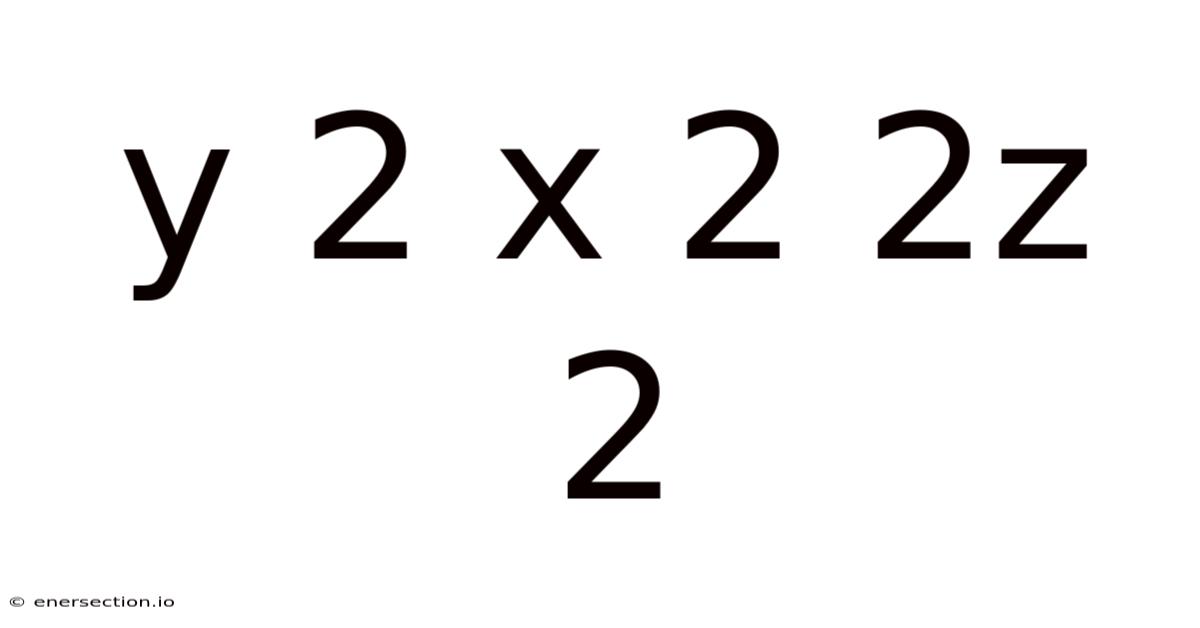
Understanding the Quadratic Form (y^{2}+x^{2}+2z^{2})
The expression (y^{2}+x^{2}+2z^{2}) appears in many branches of mathematics and physics, from geometry to optimization and from signal processing to quantum mechanics. At first glance it looks like a simple sum of squares, but the extra coefficient 2 in front of (z^{2}) gives the form distinct properties that are worth exploring in depth. Plus, this article breaks down the meaning, geometric interpretation, algebraic manipulation, and practical applications of the quadratic form (y^{2}+x^{2}+2z^{2}). Whether you are a high‑school student encountering it for the first time or a researcher looking for a quick refresher, the concepts presented here will help you grasp why this seemingly modest expression matters.
1. Introduction to Quadratic Forms
A quadratic form in three variables is a homogeneous polynomial of degree two:
[ Q(x,y,z)=a_{1}x^{2}+a_{2}y^{2}+a_{3}z^{2}+2b_{12}xy+2b_{13}xz+2b_{23}yz . ]
When the mixed terms ((xy, xz, yz)) are absent, the form reduces to a weighted sum of squares. In our case
[ Q(x,y,z)=y^{2}+x^{2}+2z^{2}, ]
the matrix representation is diagonal:
[ \mathbf{A}= \begin{pmatrix} 1 & 0 & 0\[2pt] 0 & 1 & 0\[2pt] 0 & 0 & 2 \end{pmatrix}, \qquad Q(\mathbf{v})=\mathbf{v}^{\mathsf{T}}\mathbf{A}\mathbf{v}, \quad \mathbf{v}=(x,y,z)^{\mathsf{T}} . ]
The eigenvalues of (\mathbf{A}) are simply the diagonal entries ({1,1,2}). Because all eigenvalues are positive, the form is positive‑definite, meaning (Q(x,y,z) > 0) for every non‑zero vector ((x,y,z)). This property underpins many of the geometric and analytic results discussed below Less friction, more output..
2. Geometric Meaning: Ellipsoids and Level Surfaces
Setting the quadratic form equal to a constant (c>0) defines a surface in (\mathbb{R}^{3}):
[ y^{2}+x^{2}+2z^{2}=c . ]
Dividing by (c) yields the canonical ellipsoid equation
[ \frac{x^{2}}{c}+\frac{y^{2}}{c}+\frac{z^{2}}{c/2}=1 . ]
Key observations:
- Axes lengths: The semi‑axes along (x) and (y) are both (\sqrt{c}); the axis along (z) is (\sqrt{c/2}). Because the coefficient of (z^{2}) is larger, the ellipsoid is compressed in the (z) direction.
- Cross‑sections:
- For a fixed (z=0), the cross‑section reduces to the circle (x^{2}+y^{2}=c).
- For a fixed (x) (or (y)), the cross‑section is an ellipse (\frac{y^{2}}{c-x^{2}}+2\frac{z^{2}}{c-x^{2}}=1).
- Level sets: As (c) increases, the ellipsoid expands uniformly in the (x)‑(y) plane while expanding more slowly along (z).
Understanding this shape is crucial when the quadratic form appears in optimization problems, where one often minimises (Q) subject to linear constraints. The feasible region can be visualised as intersecting a plane with the ellipsoid, producing an ellipse or a point that represents the optimal solution.
Not obvious, but once you see it — you'll see it everywhere.
3. Algebraic Manipulations
3.1 Completing the Square
Although no mixed terms exist, completing the square is still useful when the form appears together with linear terms. Consider
[ y^{2}+x^{2}+2z^{2}+2ay+2bx+4cz . ]
Group each variable:
[ (y^{2}+2ay)+(x^{2}+2bx)+(2z^{2}+4cz) = (y+a)^{2}-a^{2}+(x+b)^{2}-b^{2}+2(z+ c)^{2}-2c^{2}. ]
Thus
[ y^{2}+x^{2}+2z^{2}+2ay+2bx+4cz = (y+a)^{2}+(x+b)^{2}+2(z+c)^{2}-(a^{2}+b^{2}+2c^{2}). ]
The expression is now a sum of shifted squares plus a constant, a form that simplifies many calculus‑based proofs (e.Because of that, g. , finding minima).
3.2 Change of Variables
If a problem involves a rotated coordinate system, the diagonal matrix (\mathbf{A}) can be diagonalised by an orthogonal matrix (\mathbf{P}):
[ \mathbf{P}^{\mathsf{T}}\mathbf{A}\mathbf{P}= \operatorname{diag}(1,1,2). ]
Because (\mathbf{A}) is already diagonal, any orthogonal transformation that mixes (x) and (y) leaves the form unchanged, while mixing (z) with (x) or (y) introduces off‑diagonal terms. In practice, one often chooses a rotation that aligns the problem’s constraints with the principal axes, preserving the simple structure of the form.
4. Applications in Science and Engineering
4.1 Mechanical Vibrations
In a three‑degree‑of‑freedom mass‑spring system, the potential energy stored in the springs can be written as a quadratic form of the displacements ((x, y, z)). If the stiffnesses along the (x) and (y) directions are equal to (k) and the stiffness along (z) is (2k), the potential energy becomes
[ V = \frac{k}{2}\bigl(x^{2}+y^{2}+2z^{2}\bigr). ]
The eigenvalues of the associated stiffness matrix ((k, k, 2k)) directly give the natural frequencies (\omega_i = \sqrt{\lambda_i/m}). The larger coefficient for (z) means a higher natural frequency in that direction, a fact engineers exploit when designing vibration‑isolating structures.
4.2 Image Processing and Norms
The expression (| \mathbf{v} |_{A}^{2}= \mathbf{v}^{\mathsf{T}} \mathbf{A}\mathbf{v}=x^{2}+y^{2}+2z^{2}) defines a weighted Euclidean norm. Also, in image denoising, one may penalise changes in the colour channel (z) more heavily than those in the intensity channels (x) and (y). The resulting regularisation term encourages smoother variations in the more sensitive channel, improving visual quality.
4.3 Quantum Mechanics
For a three‑dimensional harmonic oscillator with anisotropic frequencies (\omega_x=\omega_y=\omega) and (\omega_z=\sqrt{2},\omega), the Hamiltonian (in dimensionless units) reads
[ H = \frac{1}{2}\bigl(p_x^{2}+p_y^{2}+p_z^{2}\bigr) + \frac{1}{2}\bigl(x^{2}+y^{2}+2z^{2}\bigr). ]
The term (\frac{1}{2}(x^{2}+y^{2}+2z^{2})) is precisely our quadratic form, showing that the energy levels split according to the different frequencies, a phenomenon observable in spectroscopy Less friction, more output..
4.4 Optimization and Machine Learning
In ridge regression, the regularisation term is often (\lambda|\mathbf{w}|_{2}^{2}). Also, if one wishes to penalise a particular feature more, a diagonal weight matrix (\mathbf{W}) can be introduced, leading to (\lambda\mathbf{w}^{\mathsf{T}}\mathbf{W}\mathbf{w}). Practically speaking, choosing (\mathbf{W}=\operatorname{diag}(1,1,2)) yields the penalty ( \lambda(x^{2}+y^{2}+2z^{2})). This biases the model towards smaller coefficients for the third feature, a technique useful when prior knowledge indicates that feature to be noisier or less reliable.
5. Frequently Asked Questions
Q1: Why is the form called “positive‑definite”?
A: All eigenvalues of the associated matrix are positive ((1,1,2)). This means for any non‑zero vector (\mathbf{v}), the product (\mathbf{v}^{\mathsf{T}}\mathbf{A}\mathbf{v}) is strictly greater than zero. This guarantees a unique global minimum at (\mathbf{v}=0) Still holds up..
Q2: Can the coefficient 2 be removed by scaling the variables?
A: Yes. Define a new variable (z' = \sqrt{2},z). Then
[ y^{2}+x^{2}+2z^{2}=x^{2}+y^{2}+{z'}^{2}, ]
which is the standard Euclidean norm in the transformed coordinates. That said, the scaling changes the geometry of any constraints expressed in the original variables, so the choice depends on the problem context.
Q3: How does the form relate to the distance from the origin?
A: In the weighted norm (|\mathbf{v}|_{A}), the “distance” from the origin is (\sqrt{x^{2}+y^{2}+2z^{2}}). Points with the same distance lie on the ellipsoid described earlier. This is a generalisation of the usual Euclidean distance where all axes are weighted equally That alone is useful..
Q4: What happens if one coefficient becomes negative?
A: If any diagonal entry is negative, the matrix is no longer positive‑definite; the quadratic form becomes indefinite. Its level sets turn into hyperboloids rather than ellipsoids, and the function can attain both positive and negative values, which changes optimisation behaviour dramatically.
Q5: Is there a connection to the Pythagorean theorem?
A: The classic theorem states that for a right triangle, (a^{2}+b^{2}=c^{2}). Our form is a three‑dimensional analogue, but with a scaling factor on one term. Geometrically it says that the squared “distance” to the origin is a weighted sum of the squared coordinates, extending the Pythagorean notion to anisotropic spaces Worth keeping that in mind. Took long enough..
6. Solving Equations Involving (y^{2}+x^{2}+2z^{2})
Consider the equation
[ y^{2}+x^{2}+2z^{2}=d, ]
with (d) a known constant. Solving for one variable in terms of the others is straightforward:
[ z = \pm\sqrt{\frac{d - x^{2} - y^{2}}{2}} \quad\text{provided } d \ge x^{2}+y^{2}. ]
If the goal is to find integer solutions (a Diophantine problem), the condition becomes
[ d - x^{2} - y^{2} \equiv 0 \pmod{2}, ]
so (d) must have the same parity as (x^{2}+y^{2}). Searching for solutions is then a matter of iterating over feasible (x, y) pairs and checking whether the remaining term yields a perfect square after division by 2 But it adds up..
7. Visualising the Form with Modern Tools
- 3‑D Plotting: Software such as Python’s matplotlib or MATLAB can plot the surface (x^{2}+y^{2}+2z^{2}=c). Setting
c=1gives a unit ellipsoid; rotating the view reveals the compression along the (z)-axis. - Contour Maps: Projecting the surface onto the (xy)-plane produces concentric circles, while projecting onto the (xz) or (yz) planes yields ellipses. These 2‑D slices are handy for teaching the concept of weighted distance.
8. Conclusion
The quadratic form (y^{2}+x^{2}+2z^{2}) is more than a simple algebraic expression; it encapsulates a rich geometric shape, a set of useful algebraic properties, and diverse applications across physics, engineering, and data science. This leads to its positive‑definite nature guarantees a unique minimum, while the coefficient 2 introduces anisotropy that manifests as an ellipsoid compressed along the (z)-axis. By mastering the ways to manipulate, visualise, and apply this form, learners gain a powerful tool for tackling problems that involve weighted distances, energy calculations, and regularisation techniques. Whether you are sketching an ellipsoid for a geometry class, designing a vibration‑isolating mount, or fine‑tuning a machine‑learning model, the insights presented here will help you wield the expression (y^{2}+x^{2}+2z^{2}) with confidence and precision.
